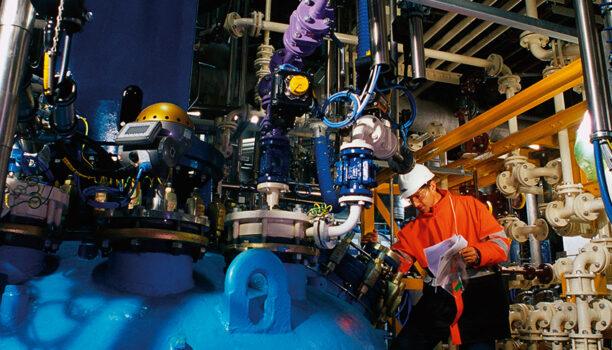
The filters used in the filtration process during API manufacturing must be compatible with all chemicals and solvents used throughout the production line.
Where there is no specific restriction, stainless steel filter housings are generally preferred. However, some syntheses require the use of solvents that are not compatible with stainless steel filtration equipment. What are the alternatives?
Applying a polymer coating to stainless steel
Cette technique consiste à isoler l’acier inox des solvants en déposant sur le corps du filtre une couche de polymères chimiquement inerte et conforme aux normes américaines et/ou européennes.
Différents revêtements sont disponibles : PTFE, FEP, PFA et Halar©. Une des solutions les plus compétitives est d’utiliser un revêtement Halar©, pour lequel les techniques de dépôt sont maîtrisées de longue date. Ce matériau offre en outre des possibilités de design nombreuses qui permettent de réaliser des filtres sur mesure.
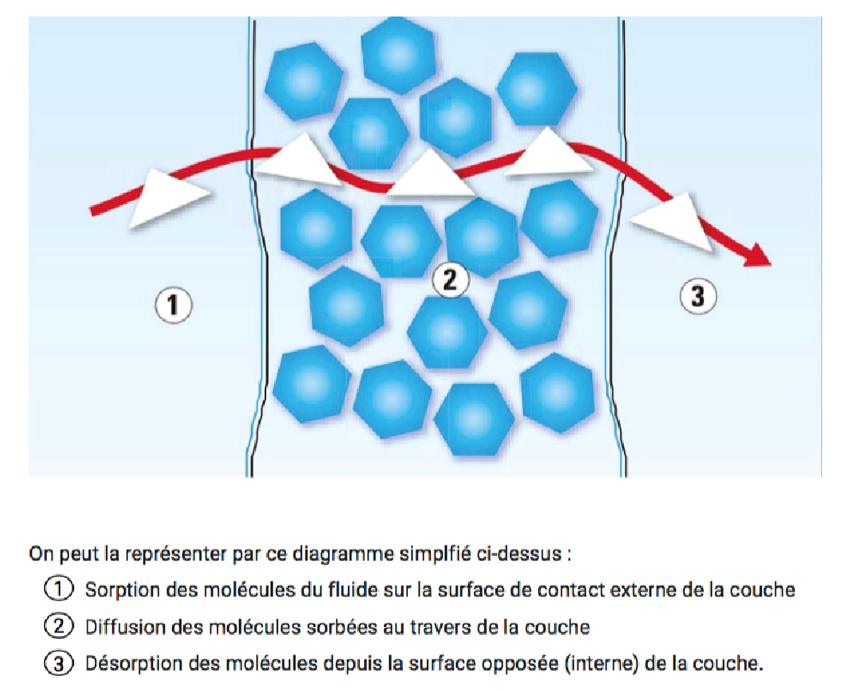
Si l’ECTFE a une excellente résistance à la corrosion, il est soumis, comme tous les revêtements en fluoropolymères, au phénomène de perméation. Les molécules qui s’adsorbent à sa surface – ici les molécules de solvant – peuvent diffuser progressivement au travers de la couche de Halar© avant de se désorber de l’autre côté. Cette migration chimique provoque à terme un délaminage du revêtement, qui doit donc être renouvelé régulièrement.
Manufacturing filter housings using polymer materials
Rather than applying a polymer coating to stainless steel, it is also possible to use solid polymer filter housings.
When filtration flow rates are low (around m³/h) and the solvents used are highly corrosive with limited chemical compatibility, one option is to use solid PTFE filter housings.
However, it should be noted that the use of this synthetic material limits the operating temperature and pressure under which the filtration housings can be used. To comply with international pressure vessel design codes (ASME, CODAP), polymer housings can only be used up to 6 bar and 40 °C.
When filtration equipment is larger (such as multi-bag filters for retaining carbon fines, catalysts, etc.), standard polymers (PP, PVDF) or thermosetting composites such as GRP (Glass Reinforced Plastic), also known as FRP (Fibre Reinforced Plastic), can be used.
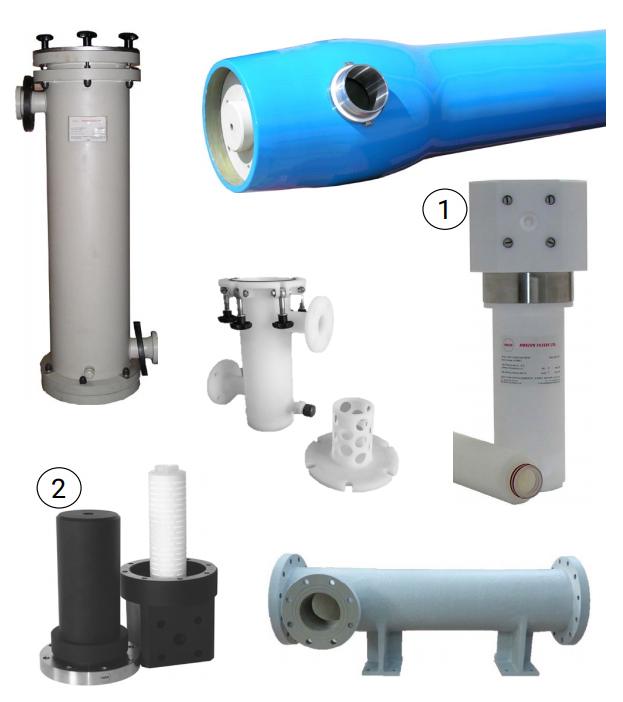
2 – Solid antistatic-treated PTFE filter housing
Manufacturing filter housings using alternative metal alloys
The standard alternative to stainless steel is Hastelloy, specifically grade C22. This nickel-based superalloy offers mechanical properties similar to stainless steel. It withstands temperatures above 800 °C and is extremely corrosion resistant, although it can still be attacked by certain aggressive acids (formic acid, acetic acid, oleum, etc.). It can also be welded and machined like stainless steel, enabling the manufacture of all types of filter housings.
Filters produced in this way can be fully compliant with international engineering and construction codes.
When the chemical and thermal compatibility of these filters is still insufficient, filter housings with a tantalum coating may be used. This combines the excellent corrosion resistance of tantalum with the mechanical strength of stainless steel, delivering performance superior to Hastelloy.
To determine the most suitable filter housing when stainless steel equipment is not viable due to solvent incompatibility, several parameters must be assessed. In addition to the technical factors, associated costs must be considered. Moreover, there is no benefit in selecting filter housings with a service life far exceeding that of the production circuit for the substance being synthesised.

Contact a filtration expert
We are at your service
Our experts place their knowledge and expertise at your disposal for liquid filtration, air and gas filtration, decontamination, and separation technologies.