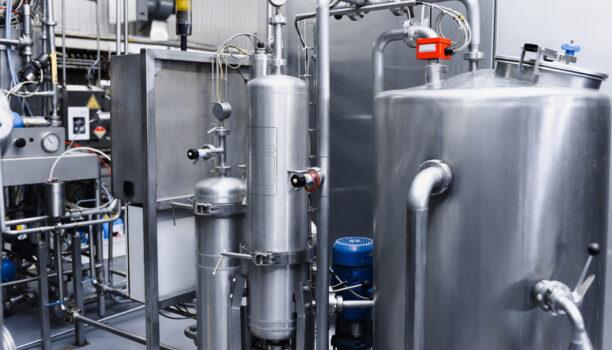
Fine chemicals develop complex molecules from organic or mineral intermediates, resulting from numerous sequential chemical reactions. The corresponding industrial units generally operate in batch mode.
They carry out complex reaction sequences with frequent operational changes (solvent types, pressure and temperature conditions, etc.). Filtration, in its broad sense, applies to raw materials, intermediates, and finished products, and is therefore intrinsically part of the processes.
One key aspect of filtration in API production is the management of utilities. The generic term “utilities” refers both to the general means required for the operation of an industrial facility—such as water, electricity, high- and low-pressure steam, gas, compressed air, etc.—and to the systems producing them.
It is therefore essential to provide process water, rinse water, “clean” steam, and “clean” gases (compressed air, nitrogen, etc.). In all these specific processes, filtration plays an indispensable role.
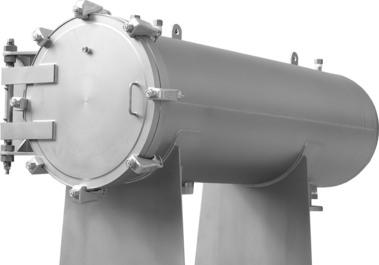
The European Pharmacopoeia distinguishes three levels of water purification based on application: Purified Water (PW), Highly Purified Water (HPW), and Water for Injection (WFI). These three purification levels are physically very similar, corresponding to low conductivity, and are primarily differentiated by their increasing microbiological purity.
Direct (dead-end) or tangential filtration is used throughout water treatment processes: on raw water, downstream of activated carbon beds, for UV lamp protection, for reverse osmosis membrane protection, for final filtration before distribution, and more.
It is important to distinguish particulate filtration, aimed at removing insoluble particles still present in the water, from microbiological filtration, used to control biological load (bacteria, endotoxins, etc.).
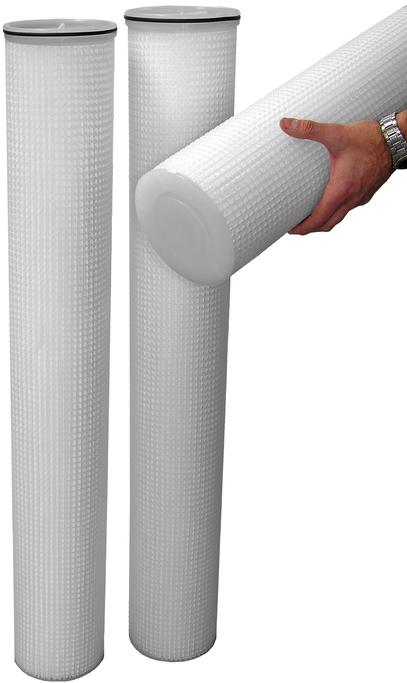
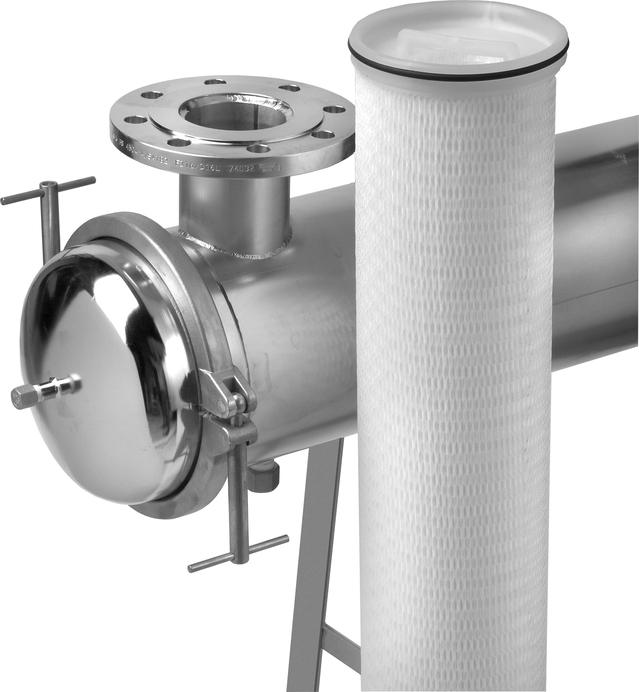
High water supply requirements, combined with limited storage capacity, generally result in relatively high flow rates (up to several tens of m³/h). In this context, for particulate retention, which imposes fewer sanitary constraints on filter housings, high surface area filter elements are increasingly preferred.
Typically, a filter cartridge from this range provides a surface area of 7 m² for a height of 40’’ (and is generally available up to 60’’). By comparison, a conventional cartridge of the same height usually offers a surface area of around 2 m².
In addition to simplifying maintenance operations (fewer filters to replace), one of the major advantages lies in better control of system sizing, resulting in optimized footprint—a critical issue when considering the need to limit, as much as possible, the space occupied by these production units.
Filter elements must strictly comply with regulatory requirements relating to bacterial retention. This was specified by the FDA in the “Guideline on Sterile Drug Products Produced by Aseptic Processing”, June 1987, which states: “Once a filtration process has been properly validated for a given process and filter, it is important to ensure that replacement filters of the same type (membrane or cartridge) used in production cycles will perform in exactly the same manner.
One way to achieve this is to correlate filter performance data with filter integrity test data. Normally, the filter integrity test is performed after assembly and sterilization of the filtration unit and before use. More importantly, these tests must be carried out after use to detect any leakage or degradation that may have occurred during filtration.” To meet this objective, it is necessary to demonstrate a correlation between bacterial retention and a non-destructive integrity test.
Note
Most manufacturers use the protocol based on the procedure documented in the chapter “Standard Test Method for Determining Bacterial Retention of Membrane Filters Utilized for Liquid Filtration” (ASTM F838-83 supersedes HIMA Document No. 3 Vol. 4, April 1982, “Microbial Evaluation of Filters for Sterilizing Liquids”). The bacterium conventionally used in this challenge is Brevundimonas diminuta (Pseudomonas diminuta) (ATCC 19146), and the required reduction must be at least 10⁷ organisms/cm², or LRV (Log Reduction Value) > 7.

Another challenge must also be addressed: maintaining stored water quality. To achieve this, hydrophobic membranes are used. Either, when integrity testing is required over the filter lifetime, a 100% PTFE membrane is selected; or a PTFE-impregnated membrane is used (in this case, however, no integrity test is possible).
Let us be clear: the performance, with regard to the bacterial challenge, of these two membranes is strictly identical. The same membranes validated for liquid applications are used. In fact, efficiency is higher in the gas phase, due to the much greater Brownian motion of airborne particles compared with particles present in liquids.
Conclusion
Regardless of technical, industrial, and commercial choices, it must be kept in mind that an API is the primary component of a medicinal product. As such, an API acts directly on the human body.
Quality assurance is obviously provided by Good Manufacturing Practices (GMP) and all applicable international regulations (for the record, the pharmaceutical industry is the most heavily regulated of all, with legally binding requirements). And yet, within this rigid framework, several approaches are possible in the management of filtration—or rather, of filtrations.

Contact a filtration expert
We are at your service
Our experts place their knowledge and expertise at your disposal for liquid filtration, air and gas filtration, decontamination, and separation technologies.