
Business sector: Hospital activities (NAF Code 2008: 8610Z)
Company activity: Association providing comprehensive care for chronic renal failure patients undergoing outpatient dialysis
Company type: Association
Company creation period: 1995
Contact(s): Responsible Pharmacist / Technical Manager
Company context
Our client is an association whose missions include the detection of kidney disease and nephroprotection aimed at slowing the progression of renal failure. The association provides dialysis care for kidney disease and post-transplant follow-up.
Safety and technological innovation, personalization and performance of techniques, and practice evaluation and analysis of indicators & outcomes are the main drivers contributing to continuous quality improvement and patient safety.
Filtration challenge
As an expert in liquid filtration, we approached this association to offer our products and services in the healthcare sector, and more specifically regarding the purity of water used in dialysis, which is essential for patients.
Our contact manages, among other things, the maintenance of water treatment stations in hemodialysis centers. These are equipped with reverse osmosis units supplying a water loop for dialyzers.
Impurities and microorganisms can impact patients. Therefore, the water loops are equipped with filters to ensure water quality and patient safety.
In this context, the Technical Manager of the facilities expressed interest in qualifying a new filter supplier.
Pemflow filtration solution
Validation of an alternative to the existing cartridges necessarily required test procedures to ensure, at a minimum, equivalent characteristics and, where possible, technical and economic gains.
The existing filter is a sterilizing cartridge made from a hydrophilic PVDF membrane (Polyvinylidene Fluoride). Within a change control procedure, it is necessary to consider, on the one hand, the nature of the filter media (which, regardless of type, must guarantee filtration quality), and on the other hand, its long-term availability with a reasonable lead time. At present, there are significant supply constraints on PVDF.
Taking these factors into account, we chose to propose an alternative cartridge using a pleated PES membrane (Polyethersulfone).
For this application, the main technical data to be considered are as follows:
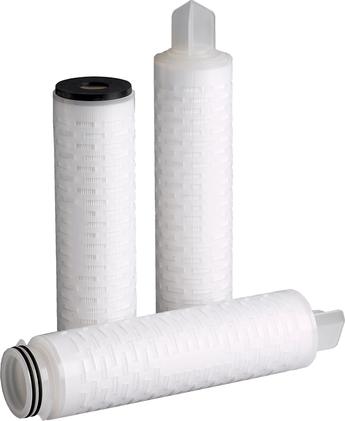
• Polyethersulfone (PES) filter media
• 0.22 µm filtration rating
• Bacterial challenge: > 10¹¹ (LRV > 11) at 0.2 µm (Brevundimonas diminuta) per 10″ module
• Silicone seals
• 20’’ length
• Code 7 end caps
The cartridge is fitted with glass fiber–reinforced end caps, compatible with the client’s standard sterilization conditions and protocols.
Measurement of a filter’s ability to render a fluid sterile is governed by ASTM F838-05 (Standard Test Method for Determining Bacterial Retention of Membrane Filters for Liquid Filtration).
In this case, the minimum bacterial retention of the cartridge (PES membrane) is 10¹¹ colony-forming units (CFU) per cm² of Brevundimonas diminuta, identical to that of the existing cartridge.
Expert advice
Filtration trials of aqueous solutions containing viruses were conducted, comparing a PVDF membrane with a PES membrane. While no difference was observed in virus recovery, PES membranes demonstrated a higher filtration rate and a longer service life (slower clogging).
Our client carried out validation trials lasting six months (representing the entire filter service period) on the water loop return line. Samples were taken regularly, with bacterial culture and quantification. Subsequently, checks against the client’s tolerance limits, notably regarding the thermal resistance of the filter under thermal disinfection conditions, completed the validation protocol for our cartridge.
Given that this is a critical application involving human health, we performed an integrity test in our laboratories to ensure that the cartridge, after six months of use, remained intact. The conclusive test report demonstrates the long-term reliability of this type of sterilizing cartridge, as well as its compliance with the bacteriological retention characteristics defined by the Validation Guide.
Note
Integrity test: a generally non-destructive test used to demonstrate the performance of the filter, and primarily its ability to meet the bacterial challenge. The most commonly used methods are diffusive flow measurement, bubble point determination, and the water intrusion test.
Each manufacturing batch is subject to validation to confirm that the endotoxin level in aqueous extracts is equal to or less than 0.25 EU/mL, in accordance with the limits defined for USP Water for Injection.
Following completion of all the tests and validations required in the healthcare field, our PES membrane successfully replaced the previous PVDF membrane. It was then deployed across the 15 dialysis centers in the department.

Contact a filtration expert
We are at your service
Our experts place their knowledge and expertise at your disposal for liquid filtration, air and gas filtration, decontamination, and separation technologies.