In manufacturing processes (for example APIs), it is essential to use filters designed and manufactured in accordance with international design codes (ASME VIII, EN 13445, and PD 5500), in compliance with the ATEX Directive and the European Pressure Equipment Directive (2014/68/EU).
In manufacturing processes (for example APIs), it is essential to use filters designed and manufactured in accordance with international design codes (ASME VIII, EN 13445, and PD 5500), in compliance with the ATEX Directive and the European Pressure Equipment Directive (2014/68/EU). Ideally, products should be selected from manufacturers accredited for self-certification under PED Module H.

The European Pressure Equipment Directive (PED) aims to harmonise the regulatory requirements of the various EU Member States with regard to placing such equipment on the market. It is a “New Approach Directive”: compliance with these requirements is demonstrated by CE marking, allowing the free movement of goods within Europe.
The Pressure Equipment Directive was revised in June 2014 to implement the principles of the New Legislative Framework. The new Directive is numbered 2014/68/EU and has been fully applicable since July 2016.
The main changes concern the rules governing notified bodies, the classification of hazardous fluids in accordance with CLP Regulation 1272/2008/EC (applicable since June 2015), as well as increased responsibilities for intermediaries (such as distributors).
The ASME VIII (American), EN 13445 (European), and PD 5500 (British) codes provide design, calculation, construction, and inspection rules for pressure equipment. In general, European codes adopt a less conservative approach, ultimately allowing the design of lighter pressure vessels than those designed under ASME codes (but with more stringent procedures and inspection processes).
Where there are no contraindications, it is generally advisable to install stainless steel filter housings. Through the addition of molybdenum (2 to 3%), providing improved corrosion resistance, grade 316L (also known as 1.4404) is almost always preferred. Furthermore, enabling custom design, it is non-magnetic, can be cold-worked, and is easily machinable.

TSo conventional that it is extremely easy to find on the market, and therefore to integrate, all types of connections:
- Threaded (BSP, NPT, etc.)
- Flanged (EN 1092-1, ANSI 150#, DIN 2633,
- Tri-clamp, SMS, RJT, IDF, DIN 11851, …
Considering batch production, i.e. relatively low-volume batches, transfer velocities very often allow the use of filter housings with a single filter element, and therefore a fairly small internal volume (typically less than 10 litres).
Among other advantages, particularly economic ones, residual volumes after fouling are reduced, thereby minimising operator exposure during maintenance operations and product losses.
The choice of equipment is primarily based on operating conditions (flow rate, pressure, temperature), but may also be driven by safety, ergonomic, or other considerations.
For the same application, and with identical filtration performance, it is for example possible to use one of the following three solutions:

1 Standard
The first one is the configuration encountered in the majority of cases (apart from the dimensions and nature of the connections, of course; it should be seen as a general layout).
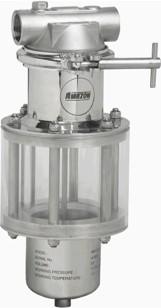
2 ClearView
The second option, known as ClearView, proves to be very effective when fluid cleanliness requires in-line visual monitoring or an initial check when a potential issue is suspected, without interrupting downstream flow and without opening the filter housing.

3 ClearView
The third option, known as ClearView, was developed to address the growing challenge of protecting the operator and the working environment.
Thus, proper sizing and design are not solely the result of construction calculation codes based exclusively on analytical data (nature of the fluid, pressure, temperature, etc.), but may also incorporate additional specifications.
Sometimes aiming to improve productivity, or in the context of continuous production, reactor charging rates can be significantly higher. In such cases, multi-element filter housings are used. Their number (and therefore, for example, the resulting filtration surface area) depends essentially on the flow rate and the particulate concentration of the fluid.


Multi-cartridge filter housings
Unfortunately, some processes use solvents that are not compatible with stainless steels. In such cases, alternative solutions must be considered.
Depending on the various operating parameters, the desired designs, acceptable trade-offs, and allocated budgets, the choice may be directed towards coatings, polymer materials (PP, PVDF, GRP, PTFE, etc.), exotic metal alloys (Hastelloy C22, Super Duplex, etc.), or finally ultimate solutions (tantaline®).
Learn more about the high performance of this alloy

Contact a filtration expert
We are at your service
Our experts place their knowledge and expertise at your disposal for liquid filtration, air and gas filtration, decontamination, and separation technologies.