Why be vigilant about filter replacement
Replacing filters at appropriate intervals makes it possible to implement an optimized maintenance program. Replacing them too frequently and excessively will lead to overly frequent production shutdowns with unnecessary costs. Conversely, realizing that the installation is malfunctioning due to non-operational filters leads to operational risks and failures that could have been avoided.
The best way to optimize a filtration system is to implement a preventive filter replacement program. Monitoring the differential pressure of the filters is a relevant tool for assessing filter aging. Differential pressure is measured as the pressure loss of a fluid passing through an obstacle, such as a filter medium. It is measured in bar as the pressure difference upstream and downstream of the filter.
Manufacturers provide replacement recommendations based on differential pressure in the technical specifications of the filters. However, it is necessary to take into account the increase in energy costs due to pump operation and the budget allocated to filter replacements—in short, finding the right compromise.
Ideally, pressure switches should be installed upstream and downstream of the filtration system, or even better, direct-reading differential pressure switches. These models can be equipped with one or more contacts to connect any type of warning system (visual, audible, automation, etc.).
In this way, a properly monitored filtration installation will operate under optimal conditions, with controlled costs and minimized downtime.
Learn more about filter replacement intervals
Filter replacement intervals: why is it important to comply with them?

Why is it important to monitor the filtration of utility production?
A clear example is air filtration. Filters gradually become clogged due to the retention of impurities. As a result, airflow is progressively restricted during operation, leading to an increase in pressure in order to maintain a constant flow rate and air quality.
Air intake or compression becomes increasingly costly as pressure rises, in order to force air through the filter to retain contaminants. A potential source of savings therefore lies in regular replacement of the filter media.
Learn more about indoor air filtration:
Sterilizing filtration of compressed air: well-controlled solutions

What about the replacement of sterilizing filters?
These filters comply with strict standards (HIMA challenge) and must be regularly sterilized to ensure optimal bacterial filtration. To do so, steam is often used. Manufacturers specify the average number of steam sterilization cycles (on the order of several hundred) that the filter can withstand. However, high temperatures impose significant stress on filtration devices. Media wear and loss of integrity are two of the causes that lead to filter replacement.
As each installation is specific—depending on its own constraints, the nature of the products to be filtered, or the particle content of raw materials—it is necessary to both follow the manufacturer’s recommendations and adapt to the specific operating environment.
Find an example of sterilizing filtration:

Should a single filter be replaced, or the entire filtration system?
The same question arises for dust collectors. A dust collection system is sized according to two main criteria: the particle size to be retained and the total air volume to be treated. At initial installation, all filters are new and installed in parallel, ensuring uniform flow rate and airflow distribution.
When only one defective filter is replaced, it is subjected to significant stress and becomes abnormally overloaded until its flow rate equals that of the other filters. This period is detrimental to its service life and will impact the entire installation. Replacing all worn filters is a far better investment than performing a single replacement of one or more damaged filters.
Here is an example of dust collection in the food industry:

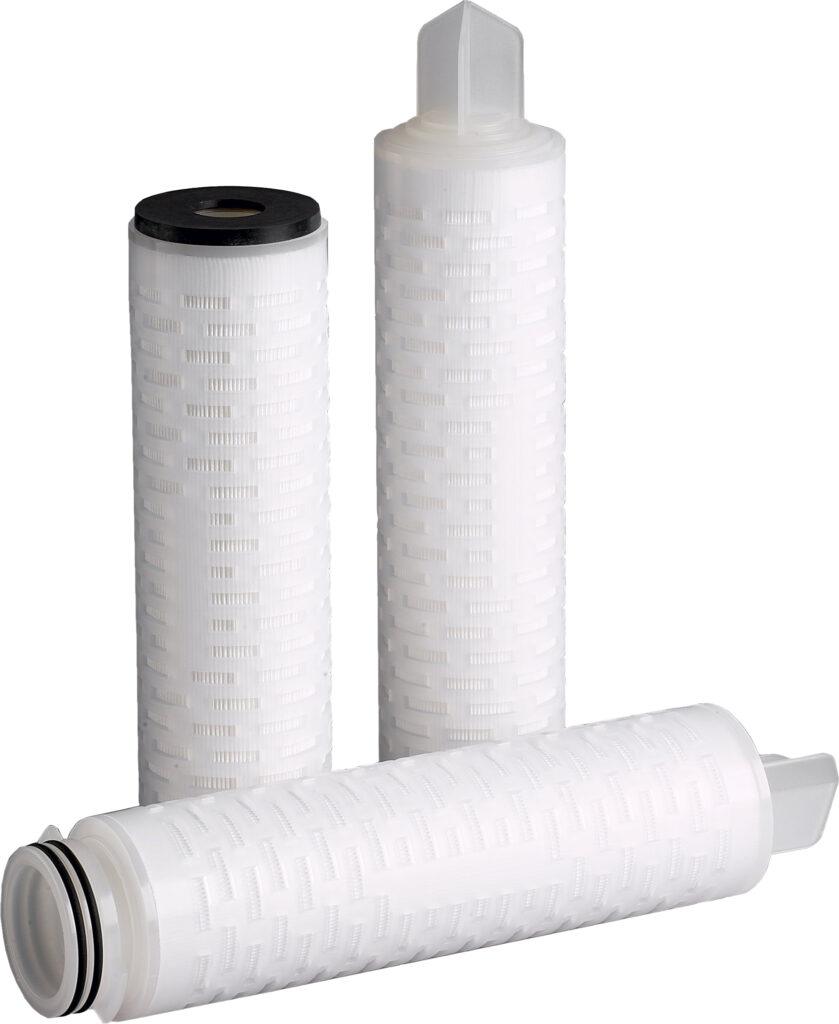
Replacing filters means:
- Complying with specifications
- Meeting safety standards
- Controlling the energy consumption of installations
- Managing operating costs
- Limiting production downtime
- Meeting deadlines
- Reducing product recalls due to potential filtration defects

Contact a filtration expert
We are at your service
Our experts place their knowledge and expertise at your disposal for liquid filtration, air and gas filtration, decontamination, and separation technologies.