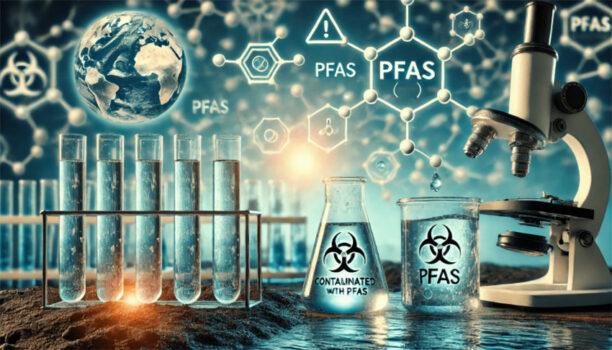
Per- and polyfluoroalkyl substances, known as PFAS (pronounced “pifass”), are the subject of significant concern in terms of public health and the environment. Used for decades for their non-stick, waterproofing and high-temperature resistance properties, these “forever pollutants” are now found in drinking water, soils, and even in the blood of the majority of the population. Their persistence in the environment and their potentially harmful effects on human health highlight the urgency of managing these substances effectively.
In response to this urgency, manufacturers and suppliers of filtration systems and consumables offer products designed to remove these persistent substances, with the aim of delivering safer water and a healthier environment.
Pemflow, in this article, presents key information on PFAS and explores current filtration technologies, their characteristics and their advantages.
PFAS: definition, uses & concerns
Definition
PFAS (per- and polyfluoroalkyl substances), formerly known as perfluorinated compounds, are synthetic organofluorine compounds. Non-stick, waterproof and resistant to high temperatures, these substances have been widely used since the 1950s in various industrial applications and consumer products. They represent a vast family comprising several thousand chemical compounds.
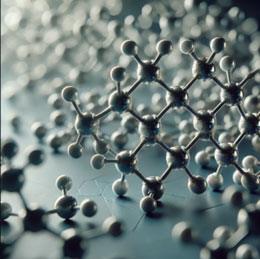
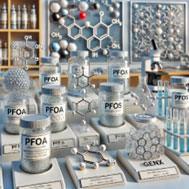
The many PFAS compounds share a key characteristic: their persistence in the environment, due to the strength of the carbon–fluorine bonds they contain. As a result, substances such as PFOS (perfluorooctane sulfonate) and PFOA (perfluorooctanoic acid) are regularly detected in the environment. Furthermore, their degradation can generate substances with shorter carbon chains.
Uses
PFAS are widely used across many industrial sectors, including firefighting foams, non-stick and chemical-resistant coatings, metal and glass coatings, waterproofing and stain resistance, semiconductor manufacturing, cable insulation and coatings, lubricants and greases, medical implants and laboratory equipment, coatings for medical devices, additives in paints and inks, solar cell manufacturing and battery components, …

They are also very commonly used in many everyday products for their waterproofing and non-stick properties:
- Non-stick kitchen utensils (such as frying pans and saucepans)
- Food packaging (papers and cardboard for greasy foods)
- Outdoor clothing
- Baking papers and moulds
- Make-up
- Car finishing and maintenance products
- …
Thanks to their high resistance, PFAS are used in many essential industries and are found in numerous aspects of daily life, from cooking and household maintenance to beauty products and leisure activities.
Concerns
Why are these substances a concern? These pollutants “will accompany humanity for hundreds, if not thousands, of years”.
Certain per- and polyfluoroalkyl substances (PFAS), notably perfluorooctanesulfonic acid (PFOS), perfluorooctanoic acid (PFOA) and perfluorononanoic acid (PFNA), have drawn the attention of researchers, regulatory authorities and non-governmental environmental organisations due to their toxicity, ecotoxicity, persistence in the environment and their already widespread presence in water, air, soil, precipitation, ecosystems (including wildlife) and in the blood of human populations and fauna. These substances are detected in living organisms worldwide; including in polar ice waters and in the air of the highest mountains.
PFAS pose significant risks to health and the environment. They are associated with various adverse effects on human health, including:
• Endocrine system disruption
• Weakened immune system
• Increased risk of certain cancers (such as kidney and testicular cancer)
• Developmental effects in children.

In addition, PFAS can contribute to increased cholesterol levels, induce cancers, affect fertility, and interfere with the endocrine system (notably the thyroid) as well as the immune system.
These substances accumulate in living organisms and spread through soils and waterways, making their removal complex and costly.
What solutions are available to remove PFAS?
Various approaches (existing or promising) can reduce their presence and impact:
- Reverse osmosis
- Ion exchange resins
- Chemical destruction such as advanced oxidation or reactions with specific reagents
- Phytoremediation
- Containment techniques
- …
Among these techniques, water treatment using activated carbon filtration is commonly employed.
PFAS filtration using activated carbon
Filtration to remove PFAS from water primarily relies on advanced treatment technologies designed to capture these persistent contaminants, such as activated carbon filters.
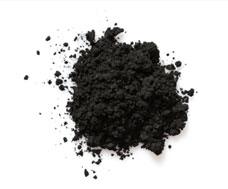
Activated carbon is produced from organic materials, such as wood or coconut shells, heated at high temperatures to develop an extremely porous structure. This porosity provides a large adsorption surface, essential for effectively trapping PFAS molecules, particularly long-chain compounds, which adsorb more readily than short-chain PFAS.
Good to know
Adsorption: adhesion of molecules, atoms and ionised species from a gas or liquid to the surface of another substance (solid or liquid), produced by a variety of weak forces.
Activated carbon cartridges are manufactured from granular activated carbon or carbon block media. Compacted carbon blocks provide more uniform filtration, as water is forced through the dense material, increasing the adsorption efficiency of PFAS. These cartridges generally outperform those made with granular carbon.
Expert advice
It is essential to pay close attention to fluid flow rate in order to optimise filtration quality without excessively slowing down the production process. Given the slow kinetics of organic adsorption, the challenge lies in finding the right balance between productivity and filtration efficiency.
Activated carbon cartridges have a limited service life, influenced by the concentration of PFAS in the water and the adsorption capacity of the cartridge. Once saturated, they lose their ability to retain PFAS and must be replaced to prevent the release of already adsorbed contaminants. Replacement frequency varies depending on cartridge type and quality, ranging from a few months to up to one year depending on the application.
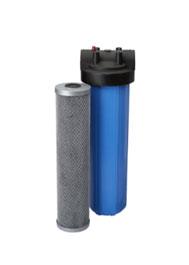
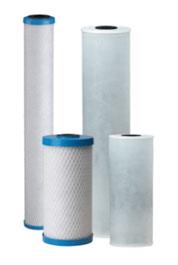
Typical cartridge sizes are 10 inches and 20 inches Big Blue.
In summary, activated carbon cartridges offer a practical and effective solution for reducing PFAS, although their performance depends on the type of PFAS present and the frequency of maintenance.
To go further, read our article Activated carbon filters: purification by adsorption

Contact a filtration expert
We are at your service
Our experts place their knowledge and expertise at your disposal for liquid filtration, air and gas filtration, decontamination, and separation technologies.