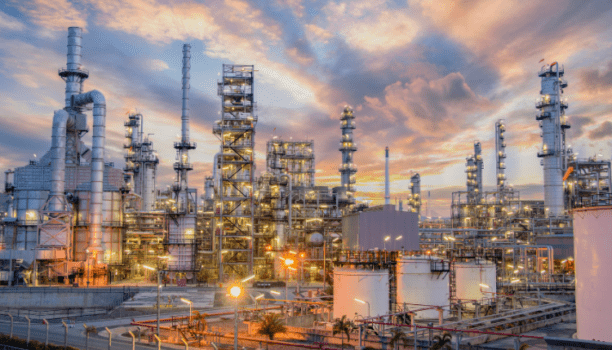
Petrochemical industries use highly specific filters to process chemically aggressive compounds, often highly viscous and at high temperatures. Depending on the field, the fluids to be filtered vary widely: oils, fuels, gases, as well as water and solvents. In oil refineries, the purity of the produced fuel is critical. In the polymer industry, filtration devices are used from the introduction of raw materials into the intermediate reactor, and then at each stage of synthesis: polymerizer, mixer, extruder, etc. The substances to be filtered there exhibit very diverse rheologies (water, solvents, molten polymers) and chemical compositions (polypropylene, polyester, polyethylene, etc.). Faced with these filtration challenges, metallic filters offer significant advantages.
From crude oil to fuels and plastics
In a refinery, crude oil is transformed into finished products in three stages: separation, conversion, and upgrading.
First stage: separating molecules by distillation according to their respective molecular weights. To do this, the oil is heated to temperatures of around 350 to 400 °C to induce evaporation in a distillation column. The crude vapors rise up the column, while the heaviest molecules, also known as heavy residues, remain at the bottom without evaporating. As the vapors rise, the molecules condense into liquids one after another according to their size, on the distillation trays distributed throughout the height of the column. Only the lightest compounds reach the top of the column, where the temperature is only about 150 °C, in gaseous form. Each tray corresponds to a distillation fraction, also known as a petroleum cut. At the base of the column are bitumens (the most viscous hydrocarbons), and at the top, gases.
It should be noted that medium-density products are often trapped within the heaviest residues. These residues are therefore subjected to a second distillation, which makes it possible to extract intermediate products (heavy fuel oils and gas oil).
After the separation phases, and in order to valorize the heavy products, these heavy molecules are broken down into lighter molecules. This conversion process, carried out at 500 °C, is known as catalytic cracking. On average, 75% of the heavy products converted in this way are transformed into gas, gasoline, and gas oil. Other processes, such as hydrocracking, make it possible to further improve this result.
Finally, a last stage, known as upgrading, makes it possible to significantly reduce the content of corrosive or environmentally hazardous molecules, such as sulfur compounds. Gas oil desulfurization is carried out at 370 °C, under high pressure (60 bar) and in the presence of hydrogen. The sulfur present in petroleum products is thus extracted in the form of hydrogen sulfide (H₂S). Kerosene, butane, and propane, for their part, are caustic-washed to remove the thiols they contain.
At the end of the refining process, each compound derived from crude oil serves a very specific use:
gasoline and gas oil are used for automotive engines, LPG (liquefied petroleum gas) is used as a fuel for gas-powered vehicles, butane and propane meet domestic needs, kerosene is used as aviation fuel, naphtha serves as a petrochemical feedstock, heating oil is used as a heating fuel, oils are used to manufacture lubricants, and finally bitumen is used for road surfacing.
Refineries: producing, filtering, and transporting fuels
In refineries, filters are used throughout the entire production chain: upstream (filtration on water injection circuits, protection of reverse osmosis membranes, process water) as well as downstream (gas separation, amine reduction, catalyst beds, etc.).
In the oil industry, large quantities of water are used to maintain pressure and increase productivity. Particular attention must therefore be paid to its quality, whether fresh or saline. Water may indeed be loaded with algae or plankton, silts, and other sediments that can impair installation performance or even cause damage.
Once the fuels are produced, they are stored in large tanks before being distributed via pipelines or tankers. During this storage phase, they can become contaminated with pollutants (rust, fine particles), which may cause issues upstream of distribution points, damage end-user equipment, or even degrade final product quality. Fuels must therefore be filtered and homogenized before delivery to remove these contaminants and any water they may contain. For this purpose, metallic media filters, or more rarely polymeric filters, are used. These systems often need to be custom-designed to fit the dimensions of the installations on which they will be installed.
Petrochemicals: producing chemically pure petroleum-based plastics
The polymer industry transforms certain compounds derived from crude oil refining (naphtha in particular) into high value-added plastics: production of PET fibers (polyethylene terephthalate) and PP (polypropylene) for the manufacture of plastic bottles, packaging films, technical thermoplastic materials, or X-ray films, etc. These plastics are obtained by polymerization, a chemical reaction that makes it possible to create a repetitive chain of small molecules, forming large molecular chains, the polymers.
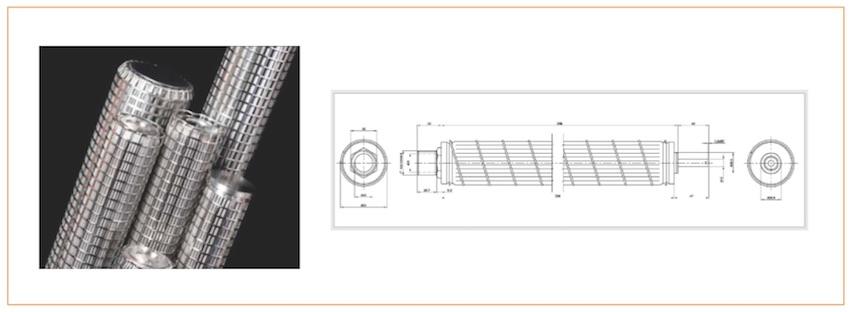
The polymer production processes from petroleum derivatives involve several filtration stages. To obtain high-quality fibers, with low breakage and high yield, the polymer melt must be homogeneous, without gel formation or significant local overconcentrations. Implementing filters helps improve the properties of the produced polymers. In the polymer industry, filter cartridges must be made from materials capable of withstanding the harsh operating conditions prevailing along the production line: high pressure and temperature, corrosion, high viscosity, etc. Metallic filtration media are therefore used in the form of pleated and cylindrical filters, capsule filters, or disc filters. These filters are supplied with a variety of end fittings to adapt to all configurations of existing filter housings or vessels.
If you would like to learn more about the different filtration solutions in the petrochemical industry, feel free to read the following articles:
Discover an example of polypropylene filtration
Learn more about polyisobutene filtration

Focus on metallic filters in petrochemicals
Metallic filters are widely used in refineries and plastic production plants derived from petroleum products, as their characteristics meet the specific requirements of these industries.
In refineries, for example, pleated filter cartridges made from metal fibers assembled by sintering are used. They offer an excellent impurity retention capacity while maintaining high porosity. They can be cleaned in place, without causing prolonged interruption of the filtration process.
To produce polypropylene films, filtration devices based on metal powders, in stainless steel or in innovative nickel-based alloys such as Hastelloy®, which are particularly corrosion-resistant, can be implemented. This type of media makes it possible to manufacture filter elements providing effective depth filtration with a long service life.
These metallic filters are available in a range of pore sizes from a few microns to submicronic structures. The filtration media are molded into cylindrical elements or in the form of pleated cartridges.
To learn more, discover our article dedicated to the use of metallic filters.
Expert advice
Regardless of the technology used (fibers, meshes, or powders), all manufactured metallic filters offer excellent mechanical strength and resistance to degradation in critical applications. They can be custom-made to perfectly fit existing installations.

Contact a filtration expert
We are at your service
Our experts place their knowledge and expertise at your disposal for liquid filtration, air and gas filtration, decontamination, and separation technologies.