Gasification is a process used to convert solid carbon-based materials (coal, petroleum coke, biomass, municipal waste, wood chips, automotive tyres, etc.) into combustible gases. Various filtration stages are involved throughout this industrial process, which takes place at high temperature and under a reducing atmosphere.
Gas production by pyrolysis
Synthetic natural gas is formed by pyrolysis in an atmosphere with a very low oxygen content to prevent combustion. Aside from a mineral fraction and a small amount of unconverted carbon that form the solid residue, the waste is converted into synthesis gas, also known as syngas. When the gasification reaction is carried out at atmospheric pressure, the gas typically consists mainly of CO and H₂, with a few percent of CH₄. Depending on the process, it may also contain CO₂, N₂, and a small quantity of long hydrocarbon chains—tars—which must be removed for certain applications.
The resulting synthesis gas is a fuel with higher energy efficiency than the original feedstocks. It can also be used to produce methanol or synthetic fuels. Downstream processes also allow the synthesis of other compounds, such as fertilisers.
Crucial industrial filtration stages
The filtration of solid residues generated during gasification takes place at various stages of production. It requires filtration devices whose design depends on the point in the process at which they operate and on the specific technology used (integrated coal gasification combined cycle, pressurised fluidised-bed combustion, gasification of biomass pellets or municipal solid waste, etc.).
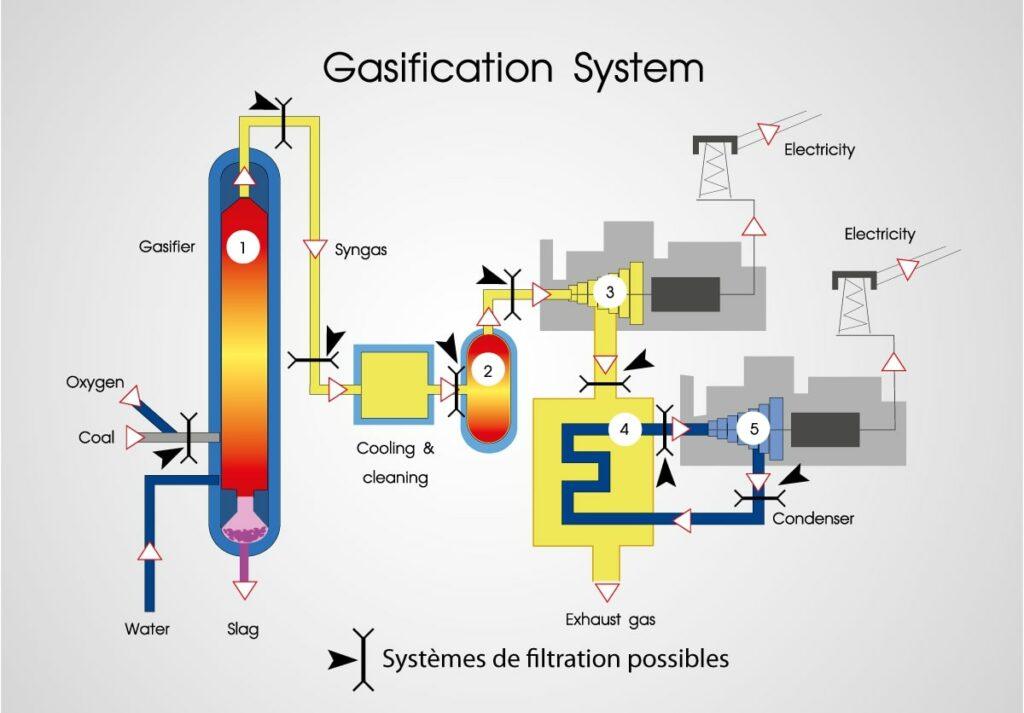
The main gas-filtration challenges are:
- filtration before the heat exchanger, typically at temperatures between 800 and 1000 °C
- filtration after the heat exchanger, this time at temperatures between 320 and 650 °C
- filtration after much more extensive gas cooling, using wet-scrubbing systems at temperatures generally below 250 °C
Using the appropriate specialised filters provides:
- improved quality and yield of the final product
- reduced system downtime, and therefore lower operating costs
- decreased unnecessary losses of process liquids
- reduced maintenance costs
- minimised damage from wear and corrosion
Prioritise metallic filters
To carry out high-temperature, high-pressure syngas filtration, it is recommended to use metallic filters. The procedure is complex, notably because of the corrosive nature of the gas and the quantity and characteristics of the carbon-residue particles formed.
Metallic filters offer numerous advantages:
- high permeability allowing high flow rates
- high and stable separation efficiency over time
- full resistance to elevated temperatures and thermal fluctuations
- the possibility of using corrosion-resistant alloys
- reduced downtime thanks to easy cleaning
- long service life
In-situ cleaning of the metal filter is essential to maintain filtration performance. This can be carried out using dedicated nozzles located above each filter element, positioned at a distance determined by operating conditions and element size, projecting a jet toward the inside of the filtering element.
Metallic filters are available in a pore-size range from a few microns down to submicron structures, manufactured from metal mesh composed…n maille métallique composite frittée et en poudre métallique frittée. Les médias filtrants sont moulés en éléments cylindriques et en formats de cartouches plissés. Ils peuvent être confectionnés sur mesure.
Expert advice
Sinterflo® porous sintered metal materials are ideal for applications involving aggressive chemicals, high temperatures, and high pressures.

Contact a filtration expert
We are at your service
Our experts place their knowledge and expertise at your disposal for liquid filtration, air and gas filtration, decontamination, and separation technologies.