A complete overview of the issue
In many industrial sectors, it is necessary to filter very hot fluids. This is the case, for example, in the chemical industry, the petrochemical industry, metallurgy, and power generation, where high-temperature gas filtration is essential to protect downstream equipment from contamination.
Here are a few examples:
Certain carbon-based materials (coal, petroleum coke, biomass, municipal waste, wood chips, automotive tires, etc.) are converted into gas, fertilizers, and chemical feedstocks through gasification or pyrolysis. These operations generate solid residues that must be removed. Depending on the process, filtration can take place at different points along the production line, each with specific temperature conditions:
• using filter elements installed upstream of the heat exchanger, at temperatures between 800 and 1,000 °C
• using filter elements installed downstream of the heat exchanger, at temperatures between 320 and 650 °C
• after much more significant cooling, using wet scrubbing systems, at temperatures generally below 250 °C
In photovoltaic cell production lines, it is necessary to remove dust particles generated during the manufacture of silicon wafers for photovoltaic cells, which are subjected to temperatures of around 1,400 °C.
In the pharmaceutical industry, it is sometimes necessary to deploy filters combining high-performance endotoxin filtration with resistance to temperatures of several hundred degrees Celsius, for example in sterilization tunnels. These laminar airflow tunnels are designed to sterilize and depyrogenate pharmaceutical glass containers, in an environment where temperatures can exceed 300 °C.
In the fields of metallurgy or cement production, high-temperature gaseous effluents containing incandescent particles are generated. The selected dust collector (cartridge, bag, or sleeve type) must also take these thermal constraints into account.
Finally, many industrial processes use steam, which must also be filtered. In the food industry, steam that comes into contact with the final product, directly or indirectly, must be of food-grade quality. In the pharmaceutical industry, quality requirements for steam are also extremely high and comply with very strict standards.
Working with high-temperature fluids places significant constraints on filtration devices as a whole. Very hot fluids can damage filter seals or certain surface coatings. In addition, in some cases, the filtration system must be thermally insulated to ensure operator safety.
In summary
- many industrial applications use high-temperature fluids
- they may circulate under high pressure and can also be chemically corrosive
- their filtration must also comply with strict quality or environmental standards
- filter media, seals, and filter housings must meet all of these requirements
Pemflow solutions
To perform high-temperature gas filtration, often under high pressure, metal filters can be used. They offer numerous advantages:
• excellent resistance to high temperatures and to temperature fluctuations
• high permeability, enabling the treatment of high flow rates
• high and stable filtration efficiency over time
• long service life
They can also be manufactured from corrosion-resistant alloys.
Metal filters are available with a wide range of pore sizes, from a few microns down to submicronic structures, manufactured from sintered composite metal mesh or sintered metal powder. The filter media are formed into cylindrical elements or pleated cartridge formats and can be custom-made.
In environments exposed to aggressive chemicals, high temperatures, and high pressures, Sinterflo® sintered metal materials are particularly recommended.
Sinterflo® cartridges are ideal for gasification and chemical production, ventilation and dust collection, dust recovery and catalytic retention, agrochemicals, and the filtration of polymers or pharmaceutical powders. They can be manufactured in stainless steel or other alloys (Inconel 601, Hastelloy, etc.).
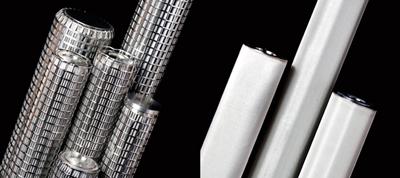
To treat high-temperature gases from cement plants or the metallurgical industry, stainless steel bag filters can be used, capable of withstanding temperatures of up to 600 °C.
For other high-temperature applications, for example in sterilization tunnels used in the pharmaceutical industry, it is possible to use filter panels made of ceramic, with a glass fiber media, resistant to temperatures of around 350 °C.
For the incineration of industrial and municipal waste, coal- or wood-fired boilers, PPS (polyphenylene sulfide) filters can be selected, which withstand temperatures of around 200 °C.
Finally, there are also filters equipped with synthetic fiber filter media, such as Kevlar® or Nomex®, compatible with temperatures of around 350 °C, which can be installed in dust collectors. Special seals and adhesives then ensure structural integrity and sealing at high temperature.

Contact a filtration expert
We are at your service
Our experts place their knowledge and expertise at your disposal for liquid filtration, air and gas filtration, decontamination, and separation technologies.