The absolute necessity of ensuring the absence of contaminants in water or solutions can represent a major challenge for pharmaceutical manufacturers, cosmetic manufacturers, and research laboratories. This article aims to shed light for those experiencing recurrent bacteriological issues within their water loop.
Limiting microbiological contamination
Maintaining the microbiological cleanliness of a purified water production and distribution system is a challenge that the pharmaceutical industry must address at all times. The major issue is assessing the actual level of contamination or the development of a biofilm without being able to access the inside of the installation.
To learn more about biofouling and the solutions to be implemented
Namely
A biofilm is a layer of micro-organisms, embedded within a solid matrix, adhering to one another and/or to surfaces. The incorporation of pathogenic organisms into biofilms can protect them from the action of biocides, even at high concentrations, which would otherwise have destroyed or inactivated them.
Indeed, microbiological sampling, as currently practised, only makes it possible to measure the quantity of “pioneer” or free-floating micro-organisms carried by the flow. Micro-organisms that are (temporarily) attached to the walls and form a biofilm are far more numerous, but remain undetectable by analysis because they are not sampled.
The biofilm therefore represents a potential time bomb, capable at any moment of releasing clusters of free cells that can attach elsewhere and develop new colonies. Taking all preventive measures to prevent the formation of biofilm is a necessary approach to ensure long-term system compliance at an acceptable cost.
First preventive measure: investment
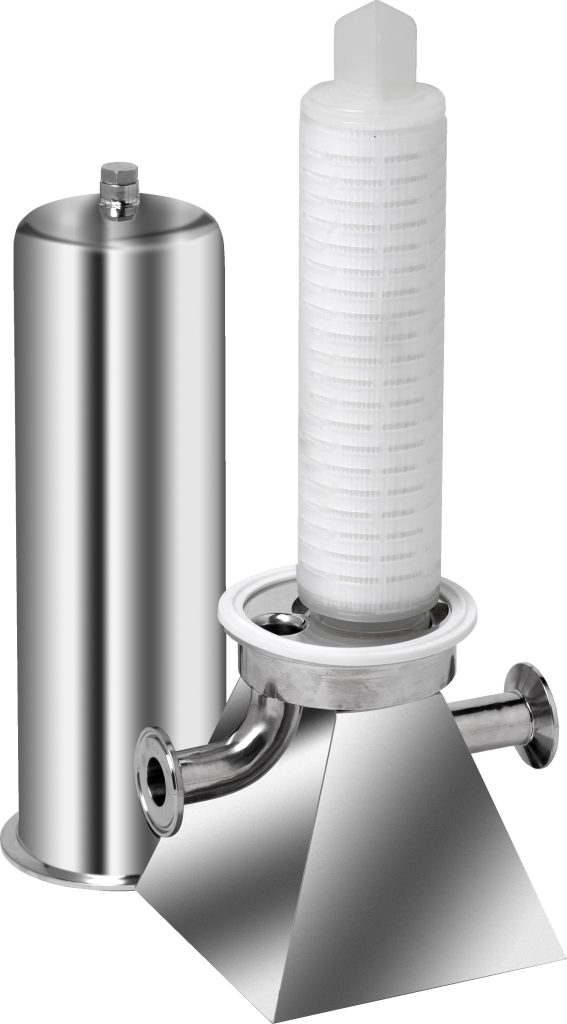
The choice of installation quality is decisive, as is often the case: a minimal investment is likely to prove more costly during operation.
High-quality stainless steel is by far preferable to most plastic materials, provided that surface finishing, weld quality, fittings, valve seats and seals, etc., are carefully executed.
Every finishing detail is important to subsequently prevent free micro-organisms from colonising surfaces by taking advantage of a roughness, a protruding weld, a crevice, a fitting, a seal, etc., and from developing a biofilm there.
Continuous or permanent bio-decontamination
It is possible to continuously destroy “pioneer” or free cells preventively before they attach to a surface. The two methods most commonly used on a continuous basis are:
- Heat
- Ozonation.
Raising the temperature poses no residue issues; 60–65°C is sufficient to destroy the “pioneers” and prevent them from establishing.
Ozone is a chemical agent that, when applied continuously, offers very good efficiency at 0.04 ppm, but this compound must be destroyed by a UV lamp at 254 nm before any point d’utilisation. Il est à noter par contre que l’utilisation d’UV 254 nm peut générer des endotoxines…
Intermittent bio-decontamination
As a replacement for or complement to a continuous treatment, intermittent bio-decontamination uses hot water, steam, or an oxidising chemical agent on a periodic basis. This spot treatment aims to kill isolated cells as well as to destroy an already formed biofilm.
Heat
Hot water is by far preferable to dry steam, which is difficult to handle, incompatible with certain equipment or materials, and requires a specially designed installation.
Moreover, steam will destroy a biofilm by effectively cooking it. These organic residues then become roughness points and nutrients that promote the attachment and development of new pioneer cells.
Hot water is not technologically simple to use, because although water at 55°C is sufficient to destroy most micro-organisms, it is not easy to maintain a high water temperature throughout an entire installation, including dead legs.
It is also necessary to eliminate thermal bridges, cold spots, plastic materials, and to flush dead legs and valves if thermal conduction is not optimal.
Expert advice
Example of recommendations for high-temperature water treatments in an ideally configured installation:
• Water at 65°C minimum 8 hours
• Water at 70°C Minimum 4 hours
• Water at 80°C Minimum 2 hours
• Water at 90°C Minimum 1 hour
Oxidising agents:
The table below summarises the main oxidising agents used and their oxidising power.
Relative oxidising power:
| Gaseous chlorine | (Cl2) | 1.00 |
| Ozone | (O3) | 1.52 |
| Peracetic acid | (CH2OOOH) | 1.33 |
| Minncare Cold Sterilant | (CH2C000H + H2O2) | >1.30 |
| Hydrogen peroxide | (H2O2) | 1.30 |
| Hypochlorous acid | (HOCl) | 1.10 |
| Gaseous chlorine dioxide | (ClO2) | 0.70 |
| Sodium hypochlorite | (NaOCl) | 0.69 |
Taking chlorine as a reference, peracetic acid is, after ozone, the most active compound on organic matter. It is marketed by many manufacturers, generally in combination with hydrogen peroxide, although purity levels may vary.
It is used by numerous pharmaceutical sites worldwide. Such a shock treatment applied to an entire installation makes it possible to destroy, according to pharmacopoeia definitions, all microbiological life, whether isolated or in the form of a biofilm.
The choice of a chemical formulation is therefore based on its efficacy, but also on the required chemical concentration; a low concentration makes it possible to minimise rinsing time, the amount of water required, and plant downtime.
Chlorinated formulations have an efficacy that is highly dependent on the pH of the solution. As purified waters have a low buffering capacity, there is always a risk of reduced effectiveness, even when concentrations are respected.
Treatments limiting the ingress of new pioneer cells
Certain equipment makes it possible to limit the ingress of pioneer micro-organisms and thus delay the formation of a biofilm and/or the occurrence of excessive contamination.
UV radiation
A UV lamp emits ultraviolet radiation that makes it possible to destroy exposed micro-organisms. This radiation significantly limits the number of pioneer cells but has no effectiveness on an established biofilm.
When used continuously on an installation, this type of lamp provides moderate to good effectiveness depending on its configuration, in order to minimise shadow zones, as well as on its sizing and the quality of maintenance. Where there is light, there is potentially shadow.
These shadow zones must be reduced as much as possible, as they constitute refuges for cells. Shadow zones may be caused by poor configuration or by an excessive number of micro-organisms, where some sacrifice themselves to protect the passage of others. This type of treatment is particularly relevant upstream of a sterilising filtration stage and helps to extend filter efficiency.
Conclusion
Effective protection against “pioneer” micro-organisms is the key to avoiding purified water contamination issues in the pharmaceutical industry. Various technologies exist and can be combined in order to improve performance.

Contact a filtration expert
We are at your service
Our experts place their knowledge and expertise at your disposal for liquid filtration, air and gas filtration, decontamination, and separation technologies.