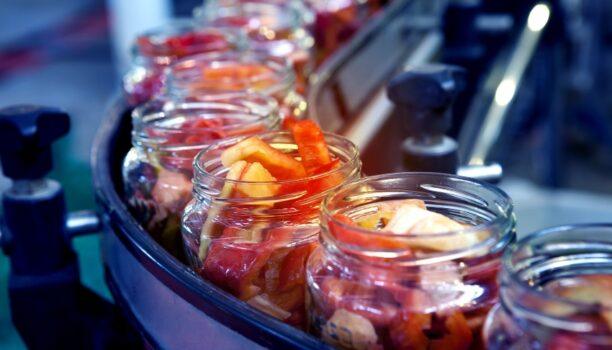
Approximately 4 billion tonnes of food are produced worldwide each year. Growing, sourcing, manufacturing, processing, packaging and distributing is no small task. And almost every stage of manufacturing involves a filter. From the steam used to clean bottling production lines to the gas used to sterilise storage tanks, filters play an essential role in the food and beverage industry. These filter media keep products clean and free from contaminants such as sediments, particles and bacteria. They also help prevent production issues that lead to product recalls; with the associated damaging consequences, particularly in terms of reputation and financial impact.
Why are filters important in food and beverage production?
Food manufacturers have a challenging task. They must ensure that facilities operate smoothly to produce high-quality products and retain an increasingly demanding customer base.
It is also important to invest in an operational, reliable and efficient production line. Costs related to personnel, energy consumption and equipment maintenance must also be taken into account.
Finally, food compliance of equipment as well as safety are paramount.
Good to know
Filters used in the food and beverage sector comply with food safety standards.
These standards ensure that products can be consumed safely, in compliance with hygiene requirements and quality criteria; and that product-related information is clear and fully accessible to consumers.
When a manufacturer encounters a non-compliance issue, the product must be withdrawn from the market and consumers informed; often with significant consequences. Filter media are therefore fundamental devices for eliminating contaminants and airborne impurities, and for equipment sterilisation.
Filters supplied to the food and beverage industries must be fully traceable and compliant with applicable regulations.


Food manufacturers must create quality products, meet production requirements, while keeping manufacturing and maintenance costs within a profitable range. This means operating efficiently, with no downtime and no product loss.
Properly sized filtration systems reduce downtime and improve product quality through higher productivity.
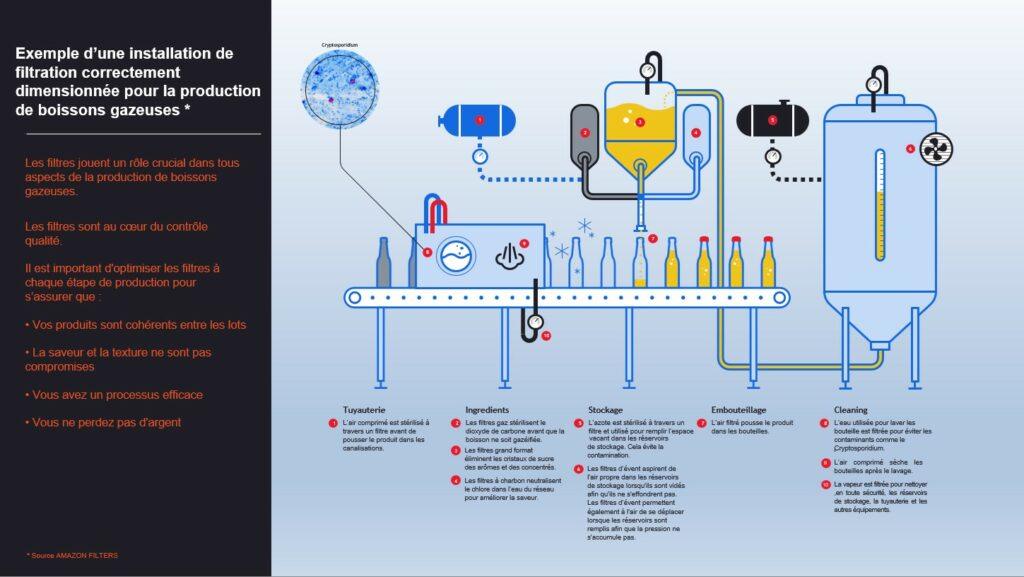
Filter media also reduce the risk of product recalls and improve the quality of food and beverages.
For example, hard water or water containing impurities can alter the quality of carbon dioxide in a beverage. Food production equipment that is not properly sterilised can develop unwanted bacteria and cause illness.
By using an appropriate filter, the risk of food product deterioration can be significantly reduced.
Cleaning packaging with sterile steam can keep it free from undesirable microbes and extend shelf life.
Utilities: a key factor in final product quality
All fluids required for the proper operation of facilities (water, high & low pressure steam, nitrogen, compressed air) are grouped under the term utilities.
Proper management of utilities is particularly important in food and beverage production, where quality standards are very high. Failure to comply with standards related to their use can lead to contamination. For example, steam that comes into contact with products must be filtered differently from steam that does not. This implies different quality requirements and therefore different filtration solutions.
This significant differentiation is part of a Good Manufacturing Practice (GMP) approach.
Good to know
Good Manufacturing Practices (GMP) are a system of processes, procedures and documentation that ensure industrial products, such as food, cosmetics and pharmaceuticals, are consistently manufactured and controlled in accordance with quality standards …
How are filters used in food and beverage production?
Filtration media are an integral part of the food and beverage production process.
Here are a few examples of filter applications contributing to the production of high-quality products.
Beer & wine
Sediments in beverages cause haze, reduce product shelf life and make them less appealing to drink. Clarification and stabilisation processes remove unwanted particles such as sugars, proteins and yeast … through filters. These processes help maintain beverage stability. If unstable, beverages may continue fermenting after bottling, altering flavour.
Removing unwanted particles through a filter medium with a reliable and consistent flow gives beverages a better appearance and a longer shelf life without altering their organoleptic properties.
Choosing a filter with a filtration rating suited to the products and organisms present is essential. A filtration cascade helps to optimise the filtration chain; rather than selecting a single filter, which would likely result in premature clogging.
Expert advice
Ensure consistency in the filtration sequence: prefiltration, fine filtration.
Prefiltration aims to remove visible particles and fine contaminants (polishing filtration).
Fine filtration is used to obtain a brilliant product or to retain pathogenic microorganisms such as yeasts, Cryptosporidium and other potentially infectious agents such as Giardia lamblia.
The prefiltration/fine filtration chain helps maintain optimum flow and protects more expensive final filters.
Fruits & vegetables
Some fresh produce is harvested and washed before sale. This applies to products robust enough to withstand washing, such as apples or carrots. Other fruits and vegetables are washed and prepared before being bagged or placed in rigid containers.
Wash water is filtered to remove microbial contaminants such as listeria and salmonella. Another source of contamination is Cryptosporidium, a parasite responsible for cryptosporidiosis.
Water filtration also removes microbes and fungal spores to extend product shelf life.
Learn more about the filtration of Cryptosporidium
Dairy industry
Dairy products require strict, efficient and consistent processes to prevent microflora and phages in the production chain. Bacteriophages, or phages, are viruses that destroy the lactic acid required to produce yoghurt and cheese. This slows fermentation and compromises the texture and flavour of the final product.
Dairy producers cannot eradicate phages, but the use of gas filters can help prevent product contamination. To maintain product quality, any gas that comes into contact with dairy products during processing must be filtered to be sterile, preventing microbial contamination and product spoilage.
Sterile gas is used to fill or empty tanks during packaging, …
An unsuitable filtration sequence or poorly selected filters can significantly compromise production and lead to substantial product losses.
Steam is also widely used in dairy processing and must be food grade. Steam is used in various applications:
- Disinfection of tanks, filling heads and other food-contact surfaces
- Preservation of products such as UHT milk
- Temperature control and product consistency
- Packaging
- Fruit and vegetable processing
- …
Poor-quality steam can damage filtration systems, contaminate the final product and result in incomplete sterilisation due to condensate build-up. The supplier must also be able to advise on piping and condensate traps for steam filtration.
What types of filters are used in food and beverage production?
| Clarification & microbiological stabilisation of wines, beers, … | Biofilm prevention Membrane protection | Chlorine reduction, odour, colour, organic traces | Elimination of Cryptosporidium | Tank venting | Steam |
|---|---|---|---|---|---|
| Beverage Grade Membrane Cartridge Pleated Depth Cartridge | Large Diameter Depth Cartridge Absolute Depth Cartridge | Activated Carbon Cartridge | Pleated Depth Cartridge | Pleated Membrane Cartridge | Sintered stainless steel filter |
Critical control points for filters
All food and beverage companies must have a management plan based on risk analysis and control of critical points. Therefore, processes often require the implementation of sterilising filters to comply with the measures described in an HACCP (Hazard Analysis of Critical Control Points) plan.
An HACCP plan helps manufacturers identify critical points where there is a risk to safety. The plan describes biological, chemical and physical hazards to food safety and the measures to be taken to minimise these risks.
- Identify and list potential hazards
- Conduct a hazard analysis
- Specify control measures
- Determine critical control points (CCPs)
- Establish critical limits
- Implement a monitoring system
- Create a corrective action plan
- Validate, verify, review
- Keep records
The integrity of filters must be checked at each critical control point to ensure proper operation and compliance with process requirements.
Integrity testing is particularly required at the following CCPs:
- Prefiltration
- Mixing and storage tanks
- Intermediate production stages
- Ingredients
- Final filtration
- Packaging
Learn more about filter integrity testing

Contact a filtration expert
We are at your service
Our experts place their knowledge and expertise at your disposal for liquid filtration, air and gas filtration, decontamination, and separation technologies.