There are two major filtration techniques involving a pressure gradient: dead-end filtration and tangential flow filtration. In the first—and most common—case, filtration occurs perpendicular to the membrane surface; in the second, the fluid flows parallel to the filtering membrane. Depending on the constraints, particularly the composition of the fluid to be treated and the required filtration performance, one technique will be preferable to the other. Explanations, examples, advantages, and disadvantages: everything you need to understand in our article.
Dead-end filtration
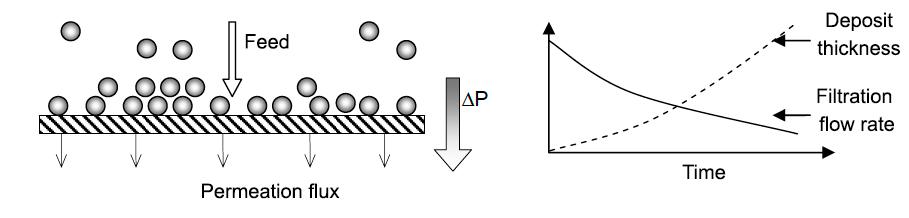
Dead-end filtration, also known as normal-flow filtration, consists of passing the fluid to be purified perpendicularly through the filter surface. This is the process used, for example, in coffee filters. The particles to be removed are trapped by the filter, meaning that the material entering the filtration module is retained by the membrane.
It is the simplest and least expensive method to implement: both the initial investment and the operating energy costs are lower than with tangential flow filtration.
However, this technique is limited by the gradual accumulation of particles on the filter surface, which progressively clogs it—reducing fluid flow and potentially leading to complete blockage. Moreover, this process never reaches a steady state, as it requires alternating filtration cycles and cleaning or replacement of the filter.
When the fluid contains too many particles to be removed, fouling and significant pressure drops render dead-end filtration ineffective. This method is therefore mainly used for low-solids suspensions.
Tangential flow filtration
In tangential flow filtration, also called cross-flow filtration, the fluid flows parallel to the filtering membrane, which it passes through under pressure. A portion of the liquid—the permeate—crosses the membrane under the effect of a pressure gradient. The larger particles become concentrated in the liquid that does not pass through the membrane, known as the retentate.
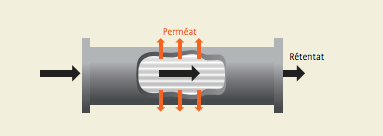
Le cisaillement, créé par la circulation tangentielle du fluide, s’oppose au dépôt des particules sur la surface de la membrane. La résistance à l’écoulement et le colmatage des meFouling phenomena on the membranes are therefore minimal compared with what occurs in dead-end filtration. Tangential flow filtration thus makes it possible to filter liquids with a relatively high particle load, while maintaining a very low cut-off and without generating pressure drop. It ensures a consistent filtration quality throughout the entire process.
Tangential flow filtration can be used in two ways, depending on which fraction of the fluid is retained and which is discarded:
• It can be used to filter the solution by removing the larger particles: in this case, the focus is on the permeate.
• Conversely, it can be used to remove the smallest particles or molecules from the fluid: here, the focus is on the retentate, which remains upstream of the filtering membrane.
In some cases, and unlike dead-end filtration, both fractions can even be recovered if they each present industrial value.

Expert advice
The tangential filter can be cleared of the slight deposit formed on its surface by reversing the flow (backwash).
Tangential flow filtration is often used in recycling and depollution operations, particularly in effluent treatment and drinking-water production. It is also widely employed in the biotechnology and pharmaceutical industries, for example to concentrate and purify therapeutic proteins. It is likewise used in the food industry.
Dead-end activated carbon filtration in the pharmaceutical industry
To remove colored impurities produced in reactors during the synthesis of pharmaceutical APIs, activated carbon is used to adsorb undesirable molecules. Rather than using loose activated carbon, it is recommended to use filter cartridges or lenticular modules equipped with activated carbon media. Purification then occurs through dead-end flow of the fluid across these filter elements. Particular attention must be paid to the fluid velocity through these elements to optimize filtration quality without excessively slowing down API production.
Learn more about activated carbon filtration
Hollow fibers: an innovative solution for dead-end filtration
Initially developed for artificial kidney production, hollow-fiber membrane technology achieves filtration performance previously unattainable in dead-end filtration, leveraging the chemical affinity of polysaccharides for certain materials. This is the principle behind the FiberFlo® dead-end filtration devices using Polyphen hollow fibers. This method is economically attractive: used in dead-end filtration systems, it delivers the full incoming flow and operates with low-capacity feed pumps. Yet, for a given filter element size, it provides a filtration surface up to three times greater than that of pleated filter membranes. It also enables selective, unmatched retention of endotoxins, molecules present in the outer membrane of certain bacteria such as Escherichia coli or Salmonella.
Learn more about endotoxins in this article
Focus on tangential ultrafiltration in the food industry
Depending on membrane pore size, several families of tangential flow filtration are distinguished. When the pores range between 1 and 100 nanometers, too small to allow bacteria, yeasts, and most viruses to pass, the process is known as ultrafiltration.
In practice, ultrafiltration is used to separate dissolved substances, whereas microfiltration (pore diameters between 0.1 µm and 1 µm) is mainly used to remove suspended particles.

Ultrafiltration is widely used in the food industry. The dairy sector alone accounts for 75% of ultrafiltration systems worldwide, particularly for concentrating whey proteins. The beverage sector uses ultrafiltration (and microfiltration) in fruit juice production and in the clarification of wine and beer.

Contact a filtration expert
We are at your service
Our experts place their knowledge and expertise at your disposal for liquid filtration, air and gas filtration, decontamination, and separation technologies.