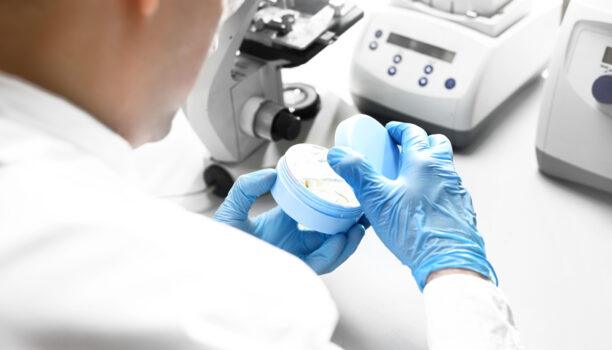
In the cosmetics sector, hygiene standards are extremely stringent. Customer expectations are high, particularly regarding creams and ointments, which must exhibit smooth, pleasant textures, uniform to the touch and visually consistent. Manufacturers therefore implement innovative production solutions to meet the demands of the cosmetics market. Filtration systems play a crucial role on production lines: they must deliver maximum efficiency while keeping operating costs under control.
The role of filters
The filters used in the manufacture of creams and ointments intervene at various stages of the formulation process. They ensure the sterilizing filtration of the water used in production and remove all particles present in the finished product. Filtration therefore provides both clarification and reduction of the bacterial load in the creams produced. The type of filtration depends on the required levels of clarity and sterility at the end of the process.
Which filters should be used?
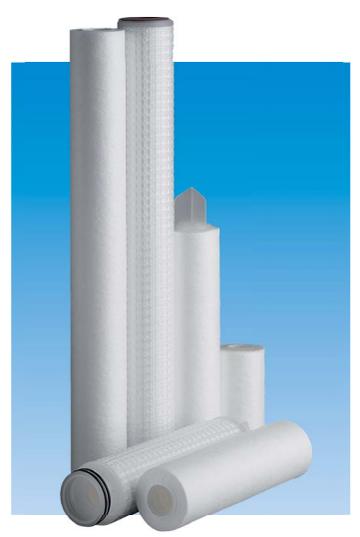
Many of the filters used in the cosmetics industry for creams and ointments rely on filtration cartridges equipped with polymer-based media (polypropylene or nylon 6), materials compliant with US FDA Title 21 and USP Class VI for polypropylene.
These are generally depth filtration cartridges with a density gradient. The microfibers of the media are thermally bonded continuously onto the central core of the filter cartridge, minimizing fiber migration. This adhesive-free manufacturing method also ensures broad chemical compatibility with solvents or raw materials used in production.
These high-performance filtration cartridges provide excellent retention capacity along with very low pressure drop. They are available in a wide range of absolute filtration ratings (from 0.5 to 80 μm). They can withstand temperatures up to 80 °C for polypropylene and 150 °C for nylon.
Expert advice
To ensure proper identification, it is recommended to select filtration cartridges with media-level marking. A lot number is also essential to guarantee full traceability.
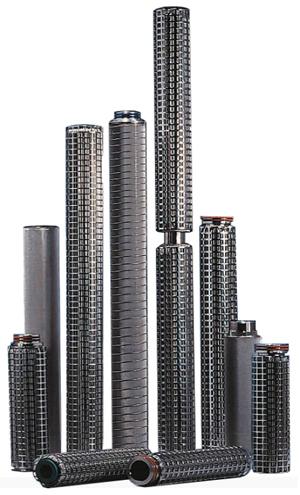
When the system operates with fluids at higher pressures, it is recommended to use 316 stainless-steel media filters. These filter cartridges are available in cylindrical or pleated configurations. They must be manufactured using processes (TIG or plasma welding) that ensure structural integrity and the absence of extractables. The manufacturing method and materials allow operation from –150 to +300 °C and up to 25 bar differential pressure in the normal flow direction.
These stainless-steel filter cartridges come in two formats. The first, cylindrical, consists of a single tube supported by a central core. The second, featuring a pleated media, offers twice the filtration surface area. Some models can be optionally reinforced to allow reverse-flow operation or backwashing.
Focus on sterilizing filtration
Water is generally the primary ingredient in creams, representing 60 to 80% of their composition. The quality of the water used is therefore critical, especially from a bacteriological standpoint. Sterilizing filter cartridges must be manufactured in a cleanroom environment, and the typical filtration rating selected is 0.2 µm.
To learn more about sterilizing filtration:
• Implementing laboratory-scale filters in cosmetics
• Manufacturing and filtering cosmetic creams and lotions: an example of production-line optimization
• Deploying a sterilizing filtration solution for a cosmetics wholesaler

Contact a filtration expert
We are at your service
Our experts place their knowledge and expertise at your disposal for liquid filtration, air and gas filtration, decontamination, and separation technologies.