How does it work?
The dimensions, volume, and shape of the filter housing depend on the characteristics of your installation and on the type of filters you wish to install (filter cartridges, filter bags, strainer baskets, lenticular modules, etc.). They are also determined by the number of filters to be installed (single or multiple cartridges or bags).
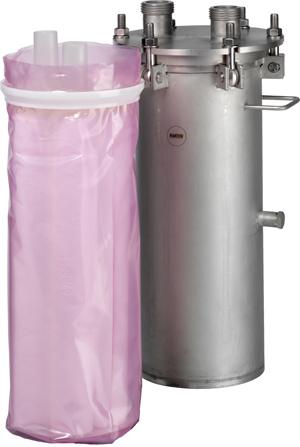
Contained filtration consists in isolating the product and the filter within a sealed enclosure. In practice, conventional cartridges are used, which are enclosed in a system of sealed plastic bags (antistatic polyethylene) before the assembly is installed in the housing, most often made of stainless steel. The SupaClean system, developed by Pemflow in partnership with the manufacturer Amazon Filters, withstands temperatures of up to 70 °C with a maximum differential pressure of 2.5 bar.
What are the advantages?
• secure filtration. Optimal protection of operators and the workstation; total containment of both the filter and the filtered product. Filter replacement is carried out with minimal risk for the operator and the surrounding environment in contact with the product,
• clean filtration. No cleaning phase is required: the plastic bags enclosing the system prevent the filtered product from coming into contact with the filter housing, which is therefore preserved. This is particularly useful in multi-product operations (paints, inks, and varnishes, for example), where, with a conventional filtration system, solvents must be used to clean the filter housing,
• cost-effective filtration. Filter replacement is simple and fast, the cleaning phase is eliminated (time savings, no use of cleaning solvents), resulting in a significant reduction in costs,
• easy storage. When packaged in this way, filters can be stored for reuse. The bags surrounding the filter cartridges can indeed serve as containers for storing filters when they are not at end of life and are intended to be reinstalled later on the production line.
Learn more about clean filtration without housing cleaning
For which applications?
Contained filtration is particularly recommended in three cases:
• industries handling hazardous materials, requiring protection of the operator and the working environment during the filtration process
• sectors such as automotive paints and coatings, where the risk of cross-contamination between different products is high
• production lines handling small quantities of products, requiring the use of a dedicated filter for each batch. This is typically the case for units producing multiple ink colors in small, occasional batches. Filters contaminated by one color cannot be used for other colors, but the entire assembly can be labeled and stored for later reuse.
In practice:
• automotive paint manufacturing
• paint, ink, and varnish equipment
• solvent manufacturing
• chemical product production
Which media should be selected?
These systems, which can be custom-designed when required, allow the use of a wide range of filter cartridges with characteristics perfectly suited to your installation. Examples include:
high-permeability cartridges, specifically developed for high-viscosity fluids, offering controlled performance to minimize pressure drop,
absolute-rated depth cartridges, combining high filtration accuracy with excellent retention capacity of undesirable particles, while also minimizing pressure drop,
cartridges with fibers continuously thermally bonded to a central core, featuring a true density gradient and a large void volume, again with low pressure drop and excellent dirt-holding capacity.
Depending on the application, the filter media may be made of nylon, polypropylene, etc.
Learn more about the SupaClean cartridge
Discover examples of contained filtration implementations:
How to ensure consistent filtration quality for lacquers and varnishes?
Varnish application: how to avoid cross-contamination?

Contact a filtration expert
We are at your service
Our experts place their knowledge and expertise at your disposal for liquid filtration, air and gas filtration, decontamination, and separation technologies.