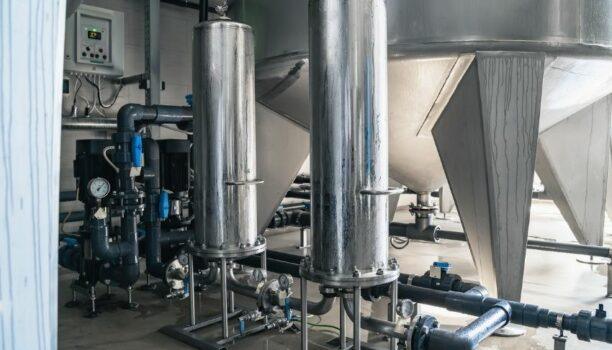
Which geometry should be selected?
The dimensions, volume, and shape of the filter housing depend on the characteristics of your installation and on the type of filters to be installed (filter cartridges, filter bags, strainer baskets, lenticular modules, etc.). They are also determined by the number of filters to be installed (single or multiple cartridges or bags).
The sizing and design of the filter housing also depend on the volume, pressure, and flow rate of the fluid to be filtered.
Depending on the case, a straight-line, L-shaped, or T-shaped configuration may be selected, with inlet and outlet piping aligned on the same central axis.
Some housings must also be equipped with sanitary vent and drain valves to facilitate degassing, draining, sampling, or integrity testing operations.
In certain cases, it may be necessary to provide thermal insulation, adapted to the circulation of steam or cooling fluid.
Finally, the ergonomics of the installation and the constraints imposed on operators must also be taken into account.
Focus on filtration skids
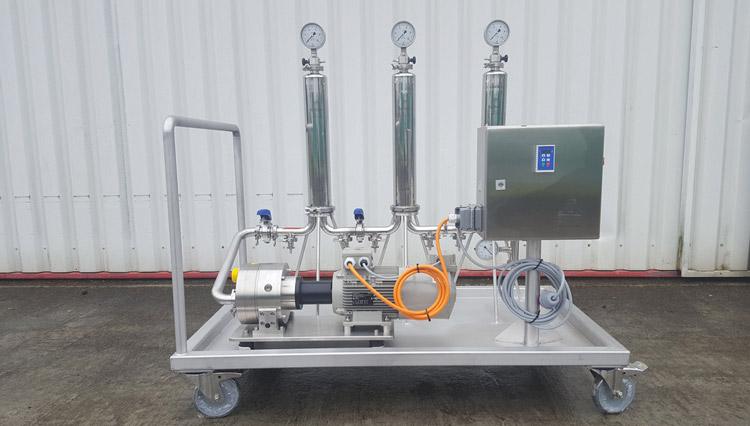
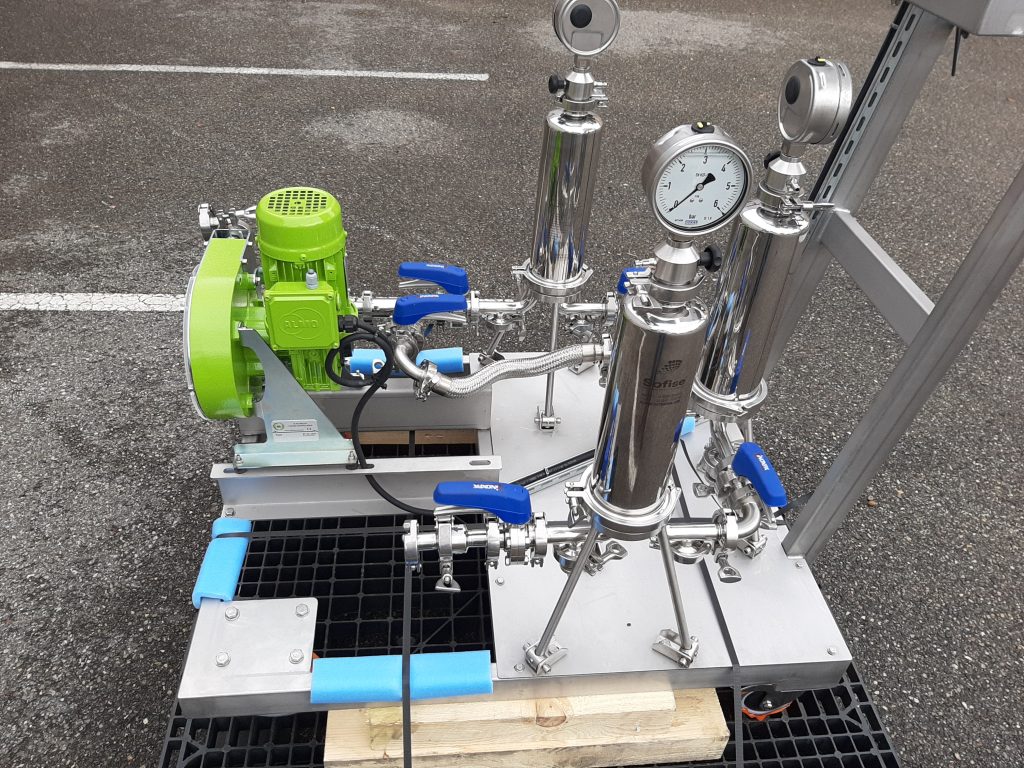
To meet certain specific requirements, the filter housing can be installed on a skid. This skid then brings together several components: a frame, a filter, pressure sensors (pressure gauges), a pump, a control panel, etc.
The skid can be mobile, allowing it to be used at different production points. Such a skid can also be used as a backup filter, for example when a batch fails quality control prior to packaging. In this case, it is used at the base of a tank or reactor.
Which material should be chosen?
Whether made of metal alloys (stainless steel, Hastelloy©, etc.) or plastics (PP, PVDF, PTFE, etc.), all filtration housings or filter bodies must be manufactured in compliance with the European Pressure Equipment Directive (PED) 97/23/EC.
The choice of filter housing material depends on the application and on the chemical and physical characteristics of the fluid to be treated. Filter housings must be compatible with all chemicals and solvents used and withstand the sometimes high temperatures present in the production process. In the absence of specific constraints, stainless steel filter housings are generally preferred, sometimes with a polymer coating. Solid polymer housings or housings made from metal alloys other than stainless steel may offer better corrosion resistance when required.
Learn more about stainless steel filter housings
In certain cases, for example in API manufacturing within the pharmaceutical industry, it is necessary to use equipment with enhanced chemical and thermal resistance. Tantalum filter housings are then used.
Tantalum is deposited by epitaxy onto the stainless steel material forming the filter housing. This results in an extremely robust, uniform, inert surface, highly resistant to corrosion and impermeable. Unlike alloys and polymers, Tantaline© filter housings offer excellent chemical resistance to various acids (sulfuric, hydrochloric and formic acids, glacial acetic acid, and strong halogenated acids). They also withstand temperatures approaching 600 °C.
Learn more about tantalum filter housings
Specific requirements for certain applications
In the pharmaceutical, chemical, and food industries, it is necessary to use filter housings manufactured with a very high level of surface finish. These housings undergo enhanced quality controls throughout their manufacturing process and are delivered in compliance with a documentation package (material certificate, surface roughness certificate, pressure resistance certificate, etc.).

When filter housings are used in terminal bacterial filtration applications, they must meet stringent requirements compatible with applicable microbiological standards (bacteria, endotoxins, etc.). Surface finishes must in particular be carefully designed and controlled to achieve roughness values on the order of 0.4 µm. These filter housings are often associated with sanitary valves, sampling valves, or diaphragm pressure gauges, which must provide the same level of assurance.

Contact a filtration expert
We are at your service
Our experts place their knowledge and expertise at your disposal for liquid filtration, air and gas filtration, decontamination, and separation technologies.