An overview of the issue
Lenticular modules offer all the advantages of conventional filter sheets, with the added benefit of operating in a closed and sterile environment. This system is ideal for applications involving hazardous products or products sensitive to their environment, by preventing any exchange with the outside. The filter media used are of the same nature as those employed for filter sheets: cellulose, synthetic fibres, diatomaceous earth, silica, activated carbon, etc. Lenticular filters make it possible, depending on your requirements, to provide surface filtration or depth filtration.
They can be used for numerous applications, in biotechnology (cell culture, blood fractionation, etc.), in the pharmaceutical industry (intermediates, cytotoxic compounds, vaccines, APIs, etc.), in the manufacture of cosmetics, and in other sectors of the chemical industry (hazardous liquids, solvents, paints, inks, surfactants, process water, etc.).
But can several lenticular modules be stacked within the same filter housing? Under what conditions and with what constraints on the filter housing?
From filter disc to lenticular module
Standard lenticular filters are composed of elementary cells. Each cell consists of two discs of filter media, separated by a polypropylene spacer. This drainage system is located at the core of the cell, on the downstream side of the two sheets, with flow occurring from the outer surface of the sheets towards the inside. A polypropylene gasket runs along the outer edge of the two discs to seal the cell.
The cells thus formed are stacked on top of one another to create a lenticular module of the desired height. Adapters attached to the central core provide overall integrity by holding each cell in position. This geometry makes it possible to maximise the filtration surface area within a given volume. The assembly is finally placed in a sealed filtration housing whose dimensions are adapted to the diameter (typically 8, 12 or 16″) and to the height of the lenticular module.
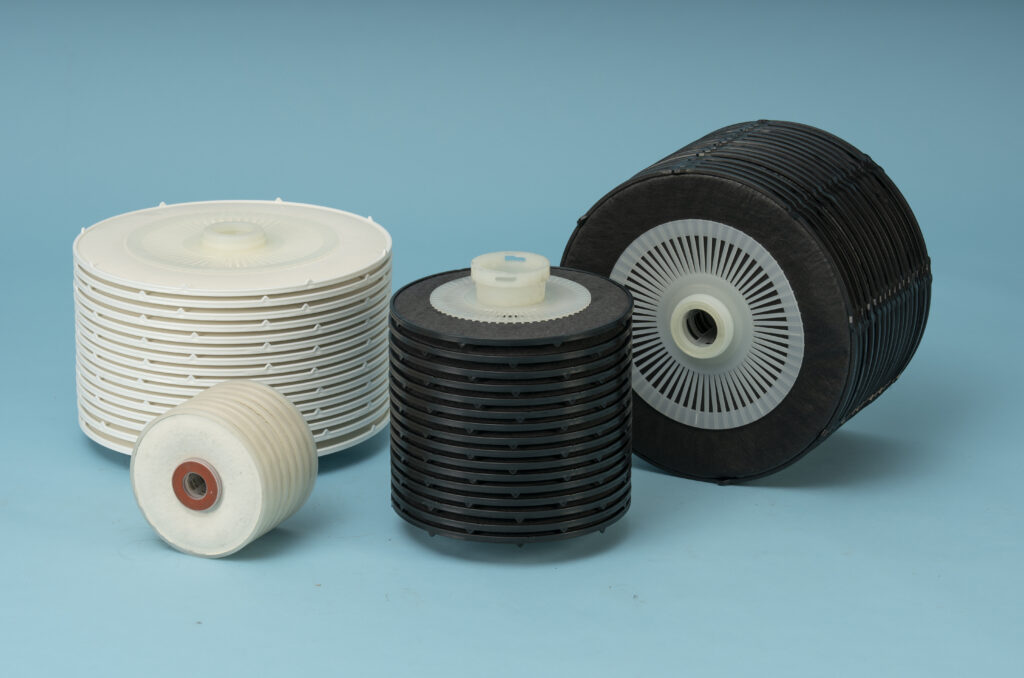
It should be noted that, in order to optimise the capacity, reliability and robustness of lenticular filters, some manufacturers offer innovative designs using double separators located on either side of the filter cells. The filter media are thus protected from mechanical stress, as if caged between these two polypropylene separators, which are either snap-fitted or joined by ultrasonic welding. The service life of these new-generation filter modules is longer than that of conventional filters thanks to improved use of the filtration surface area, the absence of obstruction of the filtering surfaces, and optimisation of incoming fluid distribution and drainage.
To find out more about new-generation lenticular modules
Pemflow solutions
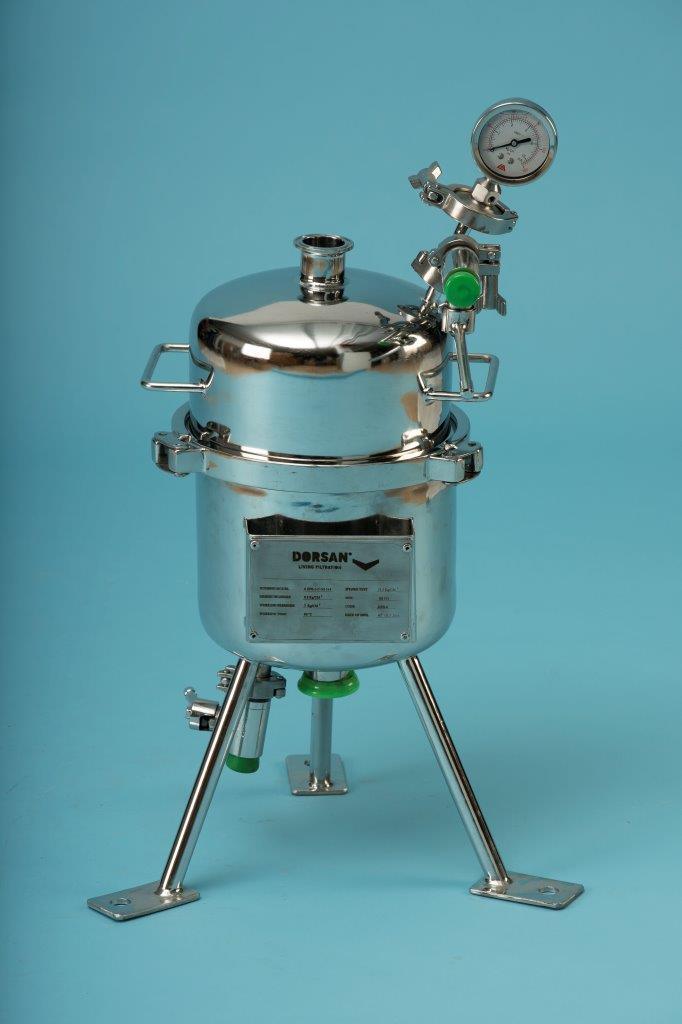
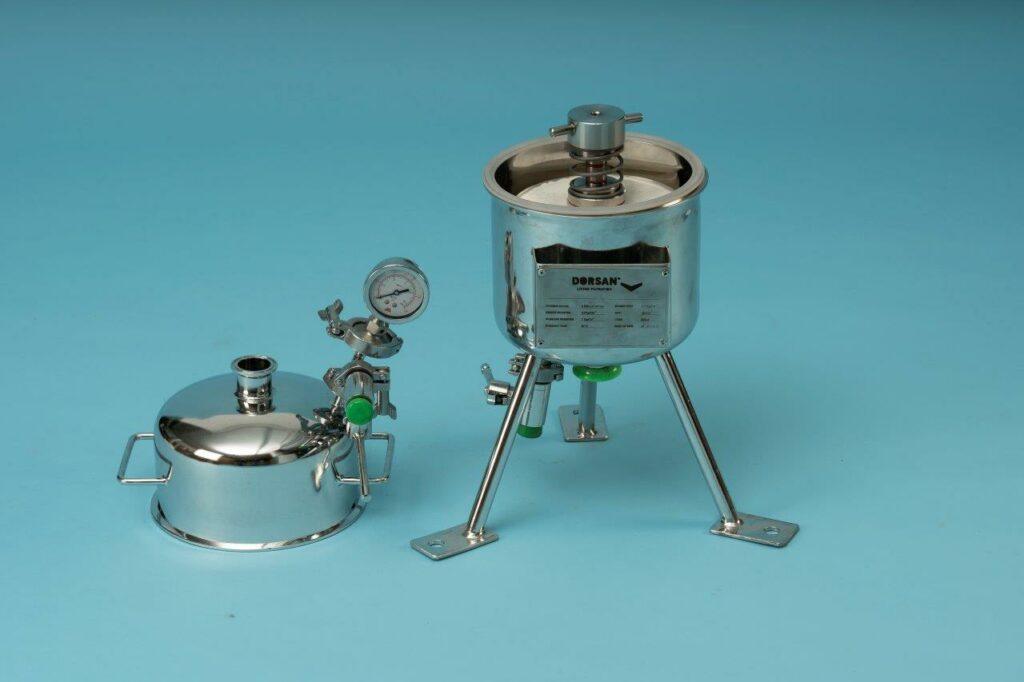
To increase the available filtration surface area and meet your filtration requirements, it is possible to use several filter modules within the same filter housing. Some filter housings, designed for this purpose, allow up to 4 modules to be stacked vertically. To limit the risk of deformation and preserve the integrity of the modules, these housings are equipped with a robust central tubular shaft. This internal rod can support the weight of saturated modules in operation, which is significantly higher than that of dry, new modules.
To further minimise the risk of crushing and damage to the filter modules, it is possible to use a horizontal housing rather than a vertical one. In a vertical configuration, the modules located at the bottom of the stack, at the base of the housing, may be crushed by the weight of the modules above them. Adopting a horizontal housing avoids this issue, as the modules are positioned side by side rather than on top of one another. This option also facilitates handling of 16″ diameter modules, whose weight is significant once wet, with a trolley allowing easy unloading of the modules.
For certain depth filtration applications, multi-column lenticular housings can accommodate up to 6 columns, each composed of 4 modules.

Contact a filtration expert
We are at your service
Our experts place their knowledge and expertise at your disposal for liquid filtration, air and gas filtration, decontamination, and separation technologies.