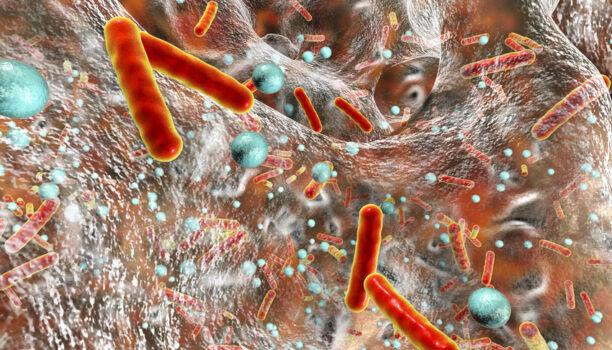
When a surface is in permanent—or at least very frequent—contact with water, an undesirable layer of living organisms, microscopic or otherwise, can form on it. This phenomenon, known as biological fouling, bio-encrustation, or biofouling, occurs in marine environments on submerged surfaces—ship hulls, buoys, moorings, etc.—that become covered by marine organisms.
It also occurs within industrial installations (pipes, valves, filtration systems, etc.), which become colonized by small algae, bacteria, and other microorganisms. How can this phenomenon be controlled? Which filters should be used? Pemflow presents the most effective solutions on the market.
Biofouling: a complex phenomenon
Microorganisms can enter the system through water, air, or both. They may be aerobic or anaerobic. The nature of the microorganisms present, their concentration, and their rate of proliferation depend heavily on several factors: water temperature and pH, presence of light, dissolved oxygen content, presence of organic and inorganic nutrients, flow rate, and the geometry of the equipment…
The risks associated with biofouling
Biofouling particularly affects nanofiltration and reverse-osmosis systems, whose membranes cannot be disinfected with chlorine.
It also occurs when bacteria (or algae) adhere to the internal walls of piping systems, especially at bends, junctions, or near filtration elements. Once adsorbed onto the walls, these bacteria progressively form a biofilm, whose thickness increases as the microorganisms multiply and dead organic matter accumulates on its surface.
Visually, the biofilm appears as greenish or brownish patches or deposits on pipe walls. It is mainly composed of gelatinous, sticky, and viscous layers.
Once established, the biofilm forms a dense, cohesive structure that is very difficult to remove. Fragments may detach regularly and spread throughout system components—including filtration membranes.
Beyond their biological risk, these biofilm fragments trapped by filters can damage them. By partially clogging them, they also force an increase in system pressure to maintain fluid flow through the filters, resulting in higher operating costs.
It should also be noted that in some cases, the biofilm may contain microorganisms that secrete biochemically aggressive compounds harmful to installation materials. These molecules can cause damage through microbial corrosion, also known as “bio-corrosion.”
Learn more about the biofilm
Biofouling: an enemy of filtration systems
Such contamination can lead to biological fouling of the filtration system, resulting in risks of filter blockage, a significant pressure drop across the filter, and the release of large quantities of unwanted microorganisms into the circuit—ultimately causing potential health risks and possible production-line failures.
Metal-based biocides and algicides for anti-biofouling protection
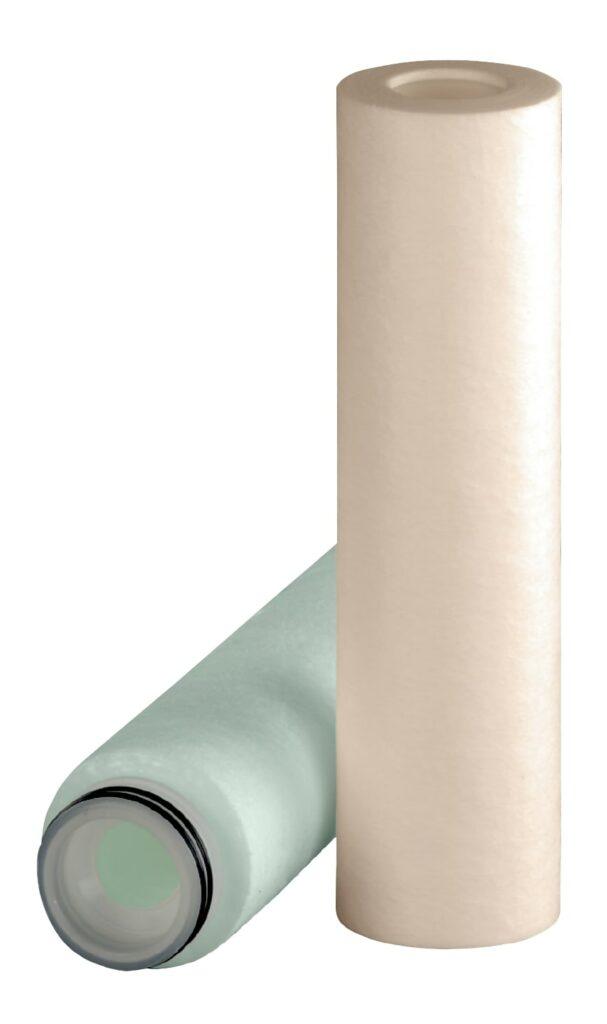
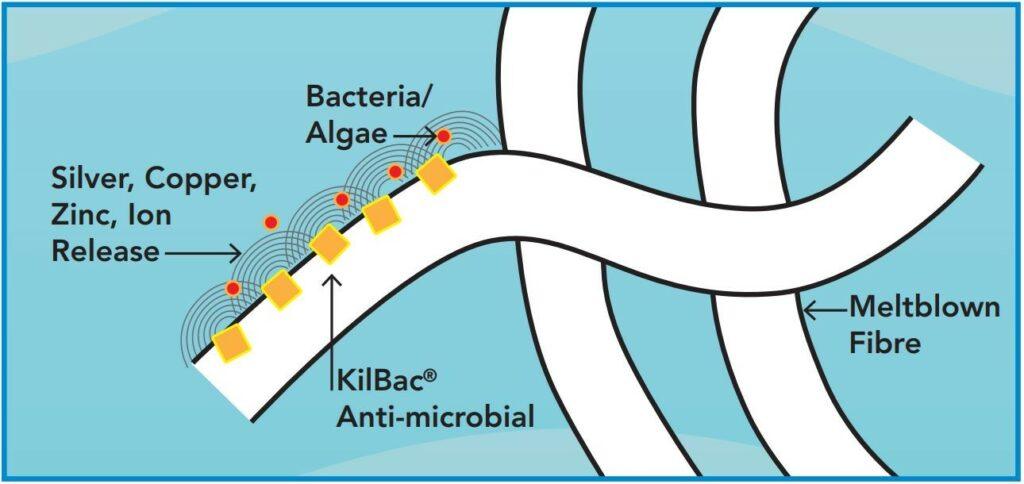
Biological fouling can be reduced by using filtration devices incorporating active silver and zinc (Ag / Zn) for an antimicrobial effect, or exploiting the silver / copper (Ag / Cu) synergy for algicidal action. These filtration devices inhibit the growth of bacteria and algae through three complementary mechanisms: they block transport across the cell wall, inhibit cell division, and disrupt cellular metabolism.
Rather than relying on nanoparticles, which may pose health or environmental risks and offer limited long-term efficiency, some manufacturers have developed filtration devices integrating zeolites as carriers for bactericidal and fungicidal agents. This approach leverages the microporous structure of zeolite, a natural mineral of volcanic origin.
Zeolites containing silver and, depending on the formulation, copper or zinc, are incorporated into the thermally bonded polymer fibers forming the filter media. The zeolites release silver, zinc, and copper in ionized forms, which destroy microorganisms. Fiber diameter and zeolite particle size are adjusted to maximize water flow and contact with the metal ions acting against biofouling, both at the surface and deep within the filter.
The result is effective depth filtration.
This innovative technology combines several advantages:
- Antimicrobial or algicidal action
- Graded-density structure for maximum retention capacity of particles to be removed
- Reduced biological fouling of filters and limited biofilm accumulation throughout the circuit
- Control of the free biological load within the water system
Expert advice
These filters are available with cut-off ratings ranging from 0.5 to 20 µm.
Proven effectiveness
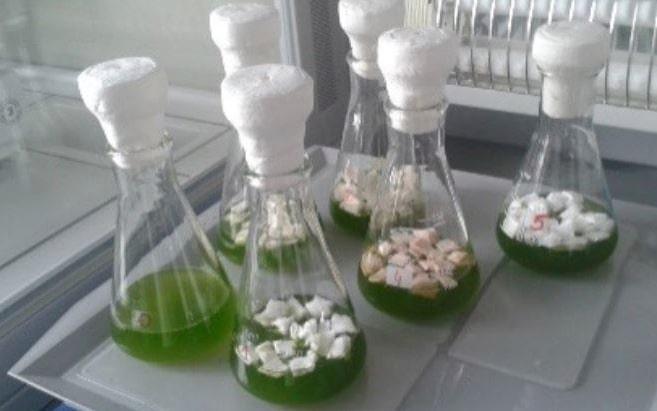
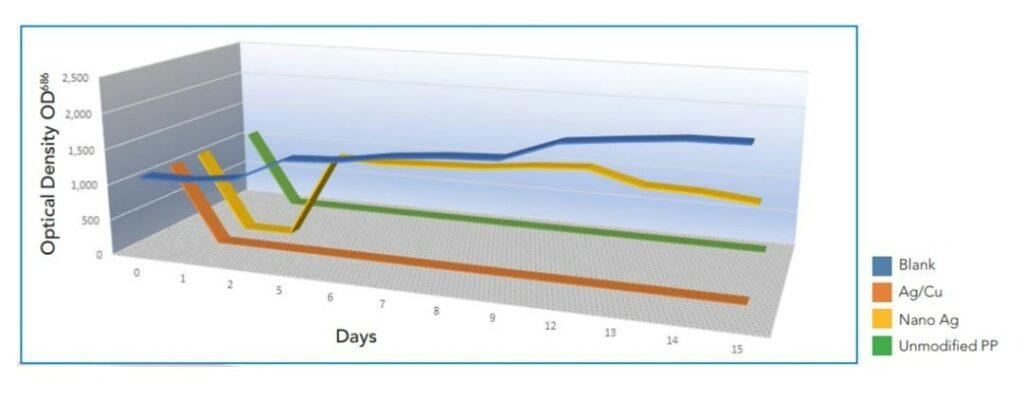
Studies have been conducted to assess the effectiveness of these filtration devices. Let us take the example of water rich in microscopic green algae of the Chlorella sp. type.
Several samples of this water are placed in flasks. Depending on the case, and in addition to a control flask, either silver nanoparticles or an Ag / Cu additive is added.
The optical density of the liquid (which increases with algal concentration) is then measured over a 2-week period to determine how the algal population evolves in each flask. The results demonstrate the excellent anti-algal properties of the Ag / Cu additive.
Which applications?
These filters are recommended for the following applications:
- Installations using seawater: prefiltration systems used in water-injection circuits for oil and gas exploration
- Processes involving intermittent flow, with stagnation risks
- Prefiltration of certain hospital equipment, such as endoscope washers
- Filters used in low-temperature hot-water (LTHW) and chilled-water (CHW) circuits, as well as in condensate treatment
Image source: Amazon Filters

Contact a filtration expert
We are at your service
Our experts place their knowledge and expertise at your disposal for liquid filtration, air and gas filtration, decontamination, and separation technologies.