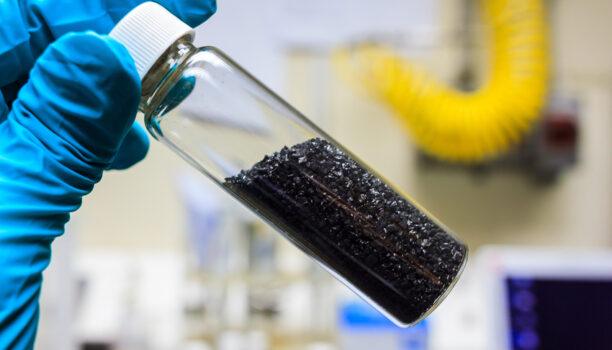
Filtration of APIs in the pharmaceutical industry, removal of fumes through fume filtration, odor filtration, water purification… The applications of activated carbon filters are numerous. How is activated carbon prepared? How do activated carbon filters work? What factors determine their efficiency? This article explains everything about the operation and use of activated carbon filters.
What is activated carbon?
Activated carbon is a material composed mainly of carbon-based matter with a porous structure. It is produced in two steps:
• Carbonization at high temperature (pyrolysis) of carbon-rich organic material such as wood, bark, coconut shells, pits, lignite, coal… At the end of this step, an amorphous and porous material is obtained: elements other than carbon leave pores within the carbon matrix as they volatilize.
• Activation, which increases its adsorption capacity by removing the tars that block the pores.
Activation can be performed physically. In this case, the material undergoes a second combustion at temperatures around 1000 °C, in a stream of air and steam injected under pressure (a process known as controlled oxidation). This operation creates millions of microscopic cavities on the surface of the carbon, dramatically increasing its surface area and therefore its adsorption capacity.
Activation can also be achieved through a chemical reaction with phosphoric acid at lower temperatures (400 to 500 °C). At the end of this process, the surface area of activated carbon can reach 400 to 2,000 m²/g.
Expert advice
The diameter of the pores obtained depends on the activation method (narrow pores for the first, wider pores for the second) and on the size of the voids originally present in the raw material used (micropores of 2 nm or less with coconut shells, pores up to 50 nm with wood, for example).
How does activated carbon work?
Le charbon actif ainsi fabriqué est capable de retenir très efficacement des gaz ou des liquides. Sa grande surface active lui confère en effet un très fort pouvoir adsorbant. Les molécules qui le traversent se fixent sur cette surface par des liaisons dites « faibles » (forces de Van der Waals, liaisons hydrogène). Le charbon actif peut être utilisé pour enlever nombre de composants, comme les phénols, les hydrocarbures saturés, les pesticides, les métaux lourds, les agents tensio-actifs…
What form of activated carbon should be used?
Activated carbon can be added directly into a reactor before being filtered, but it is also widely used as a filtration media (in the form of fibers or granules) in many filtration systems. It is then used in filter cartridges or lenticular modules, in single-pass or recirculation mode. Using these packaged formats instead of loose activated carbon offers many advantages, including eliminating a filtration step (to recover the activated carbon after adsorption), which is always tedious.
More compact, cleaner, and easier to handle than powdered carbon, these systems are also more economical. These filter elements are equipped with end caps featuring double O-rings, ensuring perfect sealing. They are manufactured from high-purity activated carbons, such as Norit SX Ultra grade. Of pharmaceutical quality, this activated carbon also meets the requirements of the Food Chemical Codex, allowing its use, for example, in API filtration.
Expert advice
Particular attention must be paid to the fluid velocity through these elements, in order to optimize filtration quality without excessively slowing down the API production process. Because the kinetics of organic adsorption are relatively slow, the right balance must be found between productivity and filtration performance.
Operational feedback confirms that this treatment solution is more compact, cleaner, easier to handle, and ultimately more cost-effective than using loose carbon.
Are activated carbon filters effective?
Many factors determine the efficiency of an activated carbon filter:
• the raw material used to manufacture the activated carbon;
• the size and density of the activated carbon particles, the filter being less effective when the carbon is in powder form;
• the exchange surface between the carbon and the gas or liquid stream;
• the number and effectiveness of the pre-filters installed upstream in the filtration train. These filters help limit fouling of the activated carbon filter, but their presence must not excessively reduce the fluid flow rate;
• the fluid flow rate through the filter;
• the condition of the filter, particularly its degree of saturation by adsorption. If the filter is saturated, it may release molecules back into the fluid instead of purifying it;
• the humidity level when filtering gases. Under high humidity, the activated carbon filter will tend to adsorb water molecules first;
• the chemical nature of the molecules to be captured, which determines the strength of the bonds established with the carbon.
What are the applications of activated carbon?
Activated carbon filters are used to purify gases and capture odors, fumes, volatile organic compounds (VOCs), fine particles, certain bacteria, and allergenic elements. They are installed in some closed-loop ventilation systems.
They are also widely used in liquid filtration systems for water purification, improving water taste, neutralizing unpleasant odors, significantly reducing chlorine levels, and retaining various chemical contaminants potentially harmful to human health (lead, pesticides, etc.). Activated carbon filters are likewise deployed in API production lines, where they purify and decolorize synthesized products by removing colored impurities formed in the reactor during the synthesis of pharmaceutical active ingredients.
To learn more about the use of activated carbon filters in API production

Contact a filtration expert
We are at your service
Our experts place their knowledge and expertise at your disposal for liquid filtration, air and gas filtration, decontamination, and separation technologies.