
What are we talking about?
Hydrogen has played a central role in industry for decades, notably in the manufacture of ammonia for fertilisers and as a gas used to start up or initiate production units in chemical refineries. Today, it is also emerging as an energy storage solution, enabling electricity generation on demand through fuel cells. It therefore represents the missing link to ensure sustainable renewable energy. Hydrogen makes it possible to store excess energy generated by wind or solar installations, making this energy available when the sun is not shining or when wind conditions are insufficient.
However, hydrogen production is not always environmentally friendly. Only hydrogen produced from renewable energy sources can truly be considered “green”.
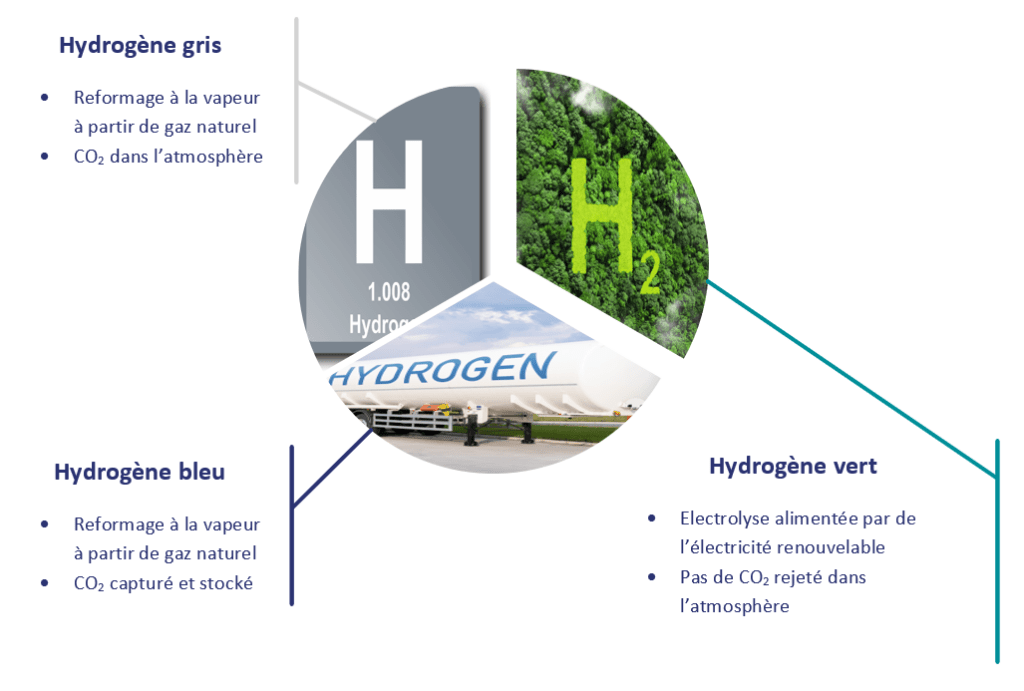
How does the process work?
The production of green hydrogen is carried out by splitting water into hydrogen and oxygen through the alkaline water electrolysis process (AWE – Alkaline Water Electrolysis), powered by renewable energy sources such as wind and solar energy.
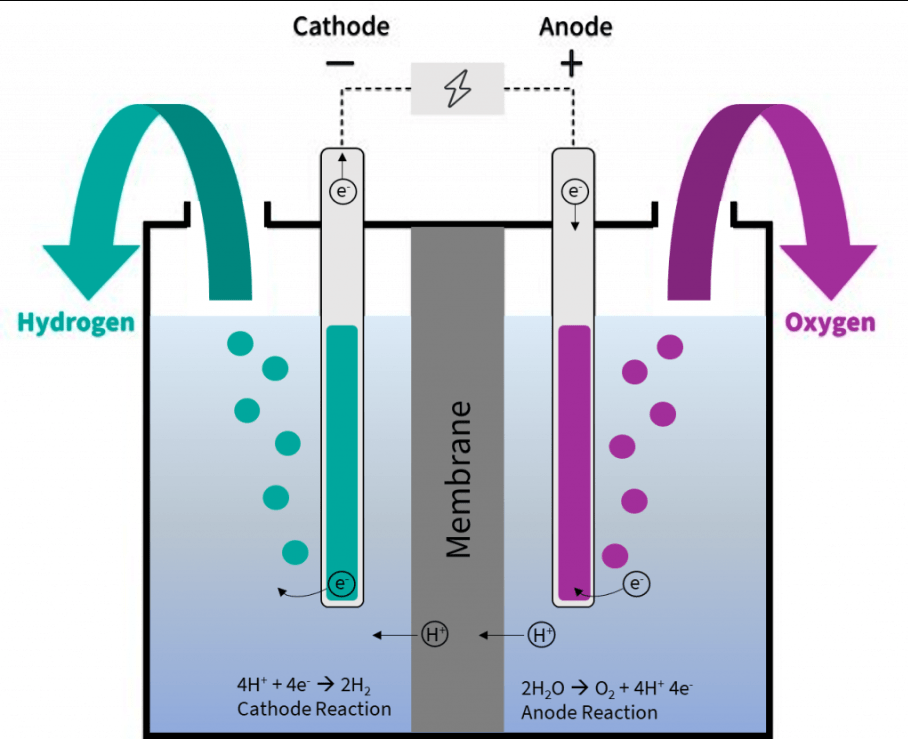
A typical alkaline water electrolysis (AWE) cell consists of two electrodes immersed in an aqueous potassium hydroxide (KOH) solution. The electrodes, generally made of nickel or mild steel, are separated by a diaphragm/membrane that is permeable to ions but impermeable to gases, thus preventing the mixing of hydrogen produced at the cathode and oxygen generated at the anode. When an electric current is applied, water is decomposed into its elemental constituents: hydrogen and oxygen.
What challenges may arise?
Advanced designs of modern AWE electrolysers now operate at pressures of approximately 3 to 4 barg and at temperatures reaching up to 80 °C. This configuration, combined with intermittent KOH concentrations of up to 50% and a hydrogen-saturated electrolyte, makes the use of standard 316 stainless steel or equivalent unsuitable, as it can lead to stress corrosion cracking (SCC).
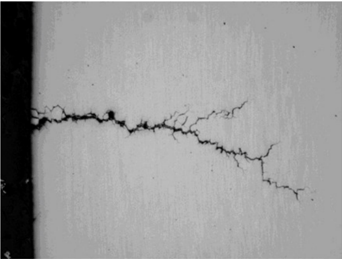
The filter plays a crucial role due to the corrosive properties of the electrolyte.
Which best practices should be adopted?
Our partner has developed a filtration system consisting of a filter housing coated with ETFE (ethylene tetrafluoroethylene). An ETFE coating is a protective layer applied to surfaces to take advantage of the exceptional properties of this fluoropolymer (outstanding chemical resistance, thermal resistance up to 150 °C in continuous operation, resistance to abrasion and impact, etc.).
When using coatings of this type, it is essential to design components carefully to ensure uniform coating thickness. Sharp edges and complex geometries can often impair the technical performance of the coating system. It is therefore crucial to work with a manufacturer that has proven, hands-on expertise in the design and application of these specific coatings.
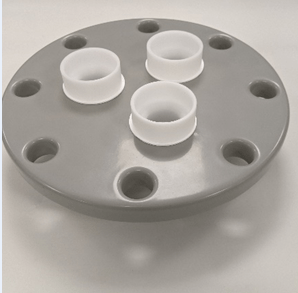
In addition, specific filter positioning cups were developed to ensure the integrity of the O-rings. Indeed, the tolerance provided by the ETFE coating proved insufficient to guarantee optimal O-ring fit in all situations.
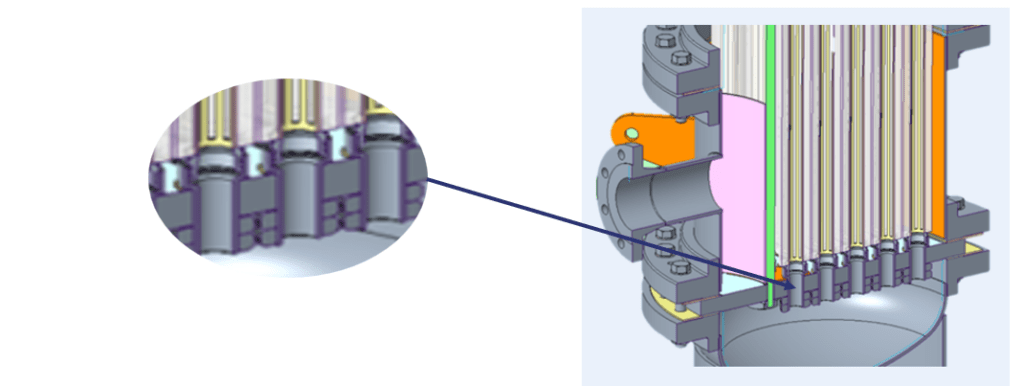
The filter housings can be equipped with 40-inch filter cartridges featuring a high pleated surface area, with an operating temperature of 80 °C.
In summary, standard market filter housings are not suitable for high-performance AWE-type electrolysers used in green hydrogen production. It is therefore essential to carefully analyse operating conditions in order to select a filter housing that is fully compatible with the constraints of the production process. Source: Amazon Filters Ltd.

Contact a filtration expert
We are at your service
Our experts place their knowledge and expertise at your disposal for liquid filtration, air and gas filtration, decontamination, and separation technologies.