Addressing the issue
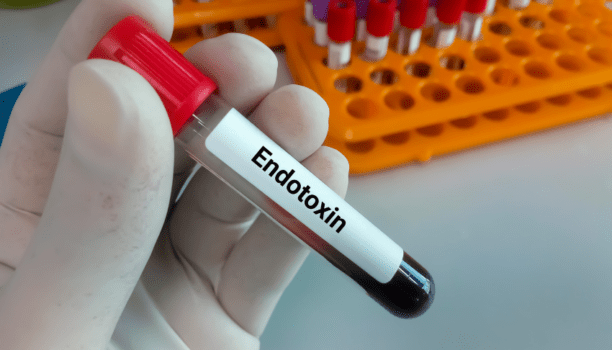
Endotoxins are toxins secreted by a microorganism during the lysis of certain Gram-negative bacteria; in other words, they are released into the environment only when the microorganism is destroyed.
Endotoxins are responsible for infections such as fulminant meningitis. Their effects range from fever to irreversible shock and can even be fatal.
Preventing contamination and the presence of endotoxins in fluids is therefore of fundamental importance in the production of products intended for patients.
To achieve this critical objective, several stages must be considered, including contamination of water distribution systems by endotoxins. Managing and controlling bacterial contamination in the water network requires the implementation of a system providing protection between the water network and the downstream process.
Conventional filter technologies are not capable of stopping endotoxins, as their retention capacities are not suitable for filtering these molecules. However, it is possible to use filter membranes with a positively charged surface which, through electrostatic attraction, can retain negatively charged endotoxins. In this configuration, however, the membrane will also retain all negatively charged compounds, leading to premature clogging.
Ultrafiltration and distillation techniques are capable of achieving endotoxin retention, but with the understanding that they involve significant capital investment and high energy costs.
In summary
Endotoxins can, in patients:
- Cause chest discomfort and coughing
- Disrupt haemostasis
- Be responsible for vascular damage
- Cause high fever
- Lead to septic shock
- Cause malaise and diffuse pain
Pemflow solutions
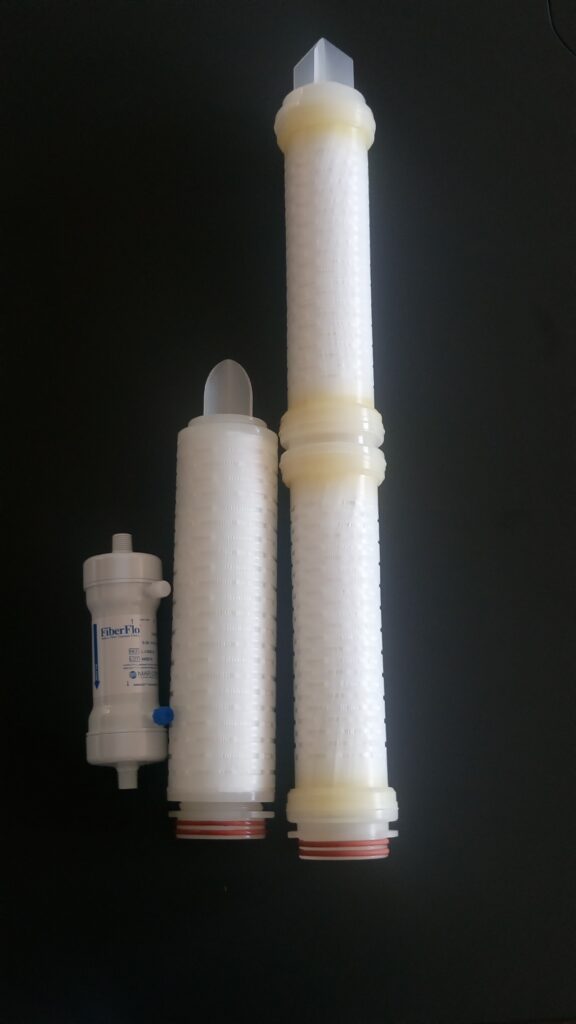
A frontal filtration solution for endotoxin retention does exist: hollow fibre technology, unlike conventional pleated membrane technology.
Meeting in particular the requirements of the pharmaceutical industry, hollow fibre technology contributes to the elimination of endotoxins, bacteria and spores.
The FiberFlo range offers filtration surfaces 2 to 3 times greater than pleated membrane cartridges. By way of example, a 10’’ FiberFlo cartridge provides a filtration surface of 1.5 m².
For the same filtration rating and thanks to their large filtration surfaces, these hollow fibre filter elements deliver flow rates up to three times higher than those of a comparable pleated filter.
Validated by a particulate challenge in addition to the standard bacterial challenge, the hollow fibre membrane provides absolute retention ratings. This means that a FiberFlo 0.2 µm filter is guaranteed absolute for 0.2 µm particles.
Another significant advantage is that FiberFlo cartridges can be installed in any type of conventional filter housing thanks to standard 222 or 226 end fittings.
Some technical data:
FiberFlo 100
Filtration rating: 0.1 µm absolute (particulate challenge)
Filtration surface: 1.5 m² per 10’’ module
Endotoxin retention validation: 1 EU/ml*
Recommended flow rate: 12–13 l/min per 10’’ module
FiberFlo 50
Filtration rating: 0.05 µm absolute (particulate challenge)
Filtration surface: 1.5 m² per 10’’ module
Endotoxin retention validation: 5 EU/ml*
Recommended flow rate: 9–10 l/min per 10’’ module
* The endotoxin detection limit set by the LAL test is 0.06 EU/ml.

Contact a filtration expert
We are at your service
Our experts place their knowledge and expertise at your disposal for liquid filtration, air and gas filtration, decontamination, and separation technologies.