In compressed-air systems, filters are used to remove impurities. While this function is essential, another contaminant also poses a significant problem in these installations. Water—both in liquid and vapor form—is often the main contaminant to filter, collect, and eliminate. It is a challenging issue to manage. Humidity, dew point, impacts on the installation, technical solutions: Pemflow breaks down the subject.
Water in the air

Ambient atmospheric air—used to generate compressed air—always contains a certain amount of water vapor, which depends on its temperature and pressure. Typically, this amounts to a few grams of water per kilogram or per cubic meter of air. During compression, the air volume decreases and its temperature rises.
This thermodynamic transformation saturates the air with humidity. When its temperature drops again—for example, as it circulates through the system using the compressed air—the water vapor condenses into liquid water. Any cooling therefore causes condensation. The temperature at which this occurs is known as the dew point.
The amount of condensed water depends on the amount of water vapor in the ambient air entering the compressor, the quantity of compressed air circulating, the temperature drop the air undergoes during compression, and the final pressure of the compressed air.
In practice, immediately after the compressor, the relative humidity reaches 100%, and droplets of water appear in the outgoing air. Any further temperature drop will cause additional condensation. The volume of liquid produced under pressure can be considerable. For example, a 30 kW compressor releases around 20 liters of water into the compressed-air line over 8 hours, with 60% humidity and an ambient temperature of 20 °C.
Focus: the dew point
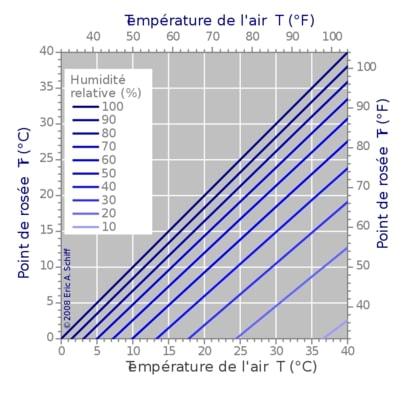
The dew point, or dew-point temperature, is the temperature at which the water vapor present in ambient air condenses into liquid water at a given pressure. The higher the humidity of the gas, the higher the dew point (in °C). In other words, the dew point is the temperature to which a volume of air must be cooled—at constant pressure and absolute humidity—for it to become saturated.
If the ambient temperature is above the dew point, no liquid water is present in the compressed air, only water vapor. If it is below the dew point, water vapor turns into liquid droplets. This relationship between saturation limit and temperature also applies to compressed air, where it is referred to as the pressure dew point.
When air is compressed, its water vapor concentration—and the concentration of particles it contains—increases significantly. It is only during cooling (in the system’s aftercooler or later in the circuit) that the excess water vapor forms condensate, once the temperature drops below the dew point. The warmer the compressor intake air, the more moisture it is likely to contain once compressed and cooled.
The term pressure dew point therefore characterizes the moisture content of compressed air. It is the temperature at which water vapor condenses at a given operating pressure. A low pressure dew point indicates that only a small amount of water vapor is present in the compressed air.
Image source: wikipedia.org
What risks for industrial installations?
Liquid water inside compressed-air lines has several detrimental effects:
- It corrodes pneumatic tools, pipes, and the compressed-air receiver. Above 50% relative humidity, this phenomenon increases significantly. If the pipelines are not galvanized, they gradually rust when moisture is high. This rust eventually flakes off, leading to clogged nozzles and failures in the installation.
- It can cause pipes and compressed-air valves to freeze in winter, especially if they are located outdoors.
- It also provides a favorable environment for microorganism growth, creating risks of bacterial contamination.
- It can degrade the quality of the final product in certain applications. Depending on the industrial sector, the following undesirable effects may occur: agglomeration of hygroscopic food powders (spices, sugar, etc.) or non-hygroscopic powders (such as sand), bubble formation causing adhesion problems or poor surface finish during painting and coating operations.
For every process, a specific humidity level and/or pressure dew point must therefore be maintained to ensure optimal long-term operation of the entire installation.
Compressed-air dryers
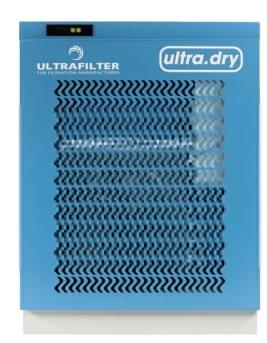
Compressed air must meet precise humidity and dew-point requirements, which vary depending on the application. To remove moisture from the compressed air, dryers are used.
Drying is generally achieved through two methods: refrigeration drying or adsorption drying. Depending on the model, industrial dryers can treat from 20 to 15,000 m³ per hour.
It is important to note that the collected condensates—which contain water, oil, impurities, and rust—must be treated before disposal in accordance with legal requirements. They form a water/oil emulsion that must be considered used oil and must not be discharged into wastewater systems or released into the environment.
Refrigerated dryers induce early condensation of the moisture contained in the compressed air by cooling it to a temperature close to the pressure dew point. This operation causes the excess water vapor to condense, after which it is collected and removed.
Using a heat-exchanger system, the air is reheated at the dryer outlet and then distributed to downstream installations. The resulting pressure dew point is around 3 °C; the dew point of the dry air expanded to atmospheric pressure is then around –20 °C. After cooling and condensation, the dried compressed air is reheated to ambient temperature.
Expert advice
It is important to protect the dryer from oily emulsions by using a filter, such as a coalescing filter. If oily aerosols enter the dryer, they quickly coat the tubing of the heat exchanger, disrupting flow and impairing its cooling capacity.
Adsorption dryers
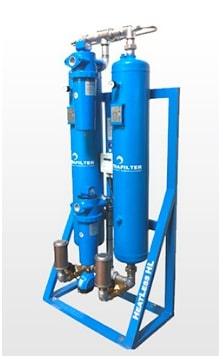
Adsorption dryers use the properties of specific desiccant materials (activated alumina, activated carbon, molecular sieves, silica gel) to trap water molecules and dry the compressed air. These dryers generally consist of two columns operating alternately in drying/regeneration mode.
Moist compressed air passes through the first column. After a certain time, the desiccant becomes saturated with water and loses effectiveness. The air to be dried is then routed to the second column, which contains fresh, dry desiccant.
While the second column is drying the compressed air, the first one is regenerated either by heating the desiccant or by purging with dry air. The regeneration phase is always shorter than the adsorption phase of the column drying the air. Using two adsorption columns in parallel allows the dryer to continuously supply dry compressed air to the user.
The dew point achieved by these systems depends on the quality of the regeneration and on the contact time between the compressed air and the adsorbent. It generally ranges between –70 and –20 °C.
Expert advice
Molecular-sieve dryers are the systems capable of achieving the lowest dew points.
Desiccant dryers must be equipped with prefiltration systems to protect the desiccant, and with downstream filtration to ensure the quality of the dry air produced.
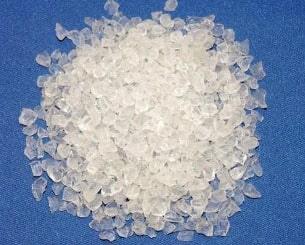

Images : www.ultra-filter.com

Contact a filtration expert
We are at your service
Our experts place their knowledge and expertise at your disposal for liquid filtration, air and gas filtration, decontamination, and separation technologies.