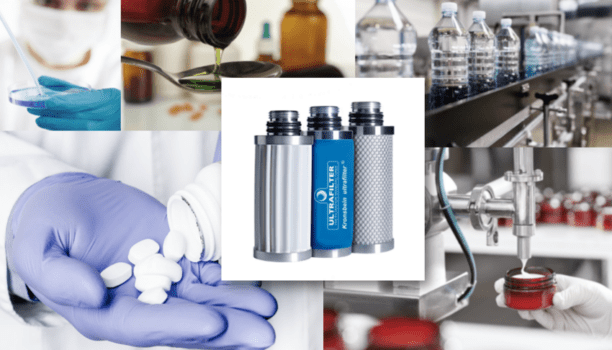
Compressed-air filters are used to remove air contaminants after compression. Type, size, filter quality… How do you choose the right filtration system to best meet each requirement? Here you’ll find our explanations and guidance to help you select the right filter for your industrial air compressor.
How is compressed air produced?
A standard compressed-air production system includes several compressors driven by electric motors, an oil and condensate separator, a buffer tank, a dryer, and particulate filters.
A typical air compressor compresses about 7 volumes of atmospheric air into 1 volume of compressed air (7 bar). Compression, followed by cooling to bring the compressed air back to ambient temperature, releases moisture.
For which industrial sectors is compressed air used?
On average, compressed air accounts for 10 to 15% of an industrial company’s electricity bill. It is the fourth most widely used utility in industry, after electricity, natural gas, and water.
It is used in sectors that rely on pneumatic controls or pneumatic conveying. It is also used for industrial cleaning, sandblasting, and painting—where it is mixed with various products. Industries using compressed air are therefore numerous: instrumentation, painting, agri-food, pharmaceutical, electronics, wood and PVC processing, grain industry, cement industry, and many more.
Where do contaminants in compressed air come from?
During production, compressed air becomes contaminated from several sources:
- The atmospheric air used as the raw material, which contains water vapor, dust, microorganisms, and potentially oil vapors
- The air compressors, which generate oily contaminants in liquid, aerosol, and vapor phases
- The storage tanks (pressure vessels) and distribution systems, which release particles generated by corrosion
Why filter compressed air?
When a gas is compressed, its molecules are “packed together,” which increases the concentration of contaminants. Compressed-gas filtration is therefore essential.
Take the example of a system producing compressed air for a pneumatic device such as a valve or actuator. At the compressor outlet, the air contains a high concentration of undesirable particles originally present in the atmospheric air, and it also acquires additional contaminants: dust, hydrocarbons, oil, rust, water…
All these impurities can reduce the efficiency of equipment using compressed air, cause malfunctions, or even lead to breakdowns.
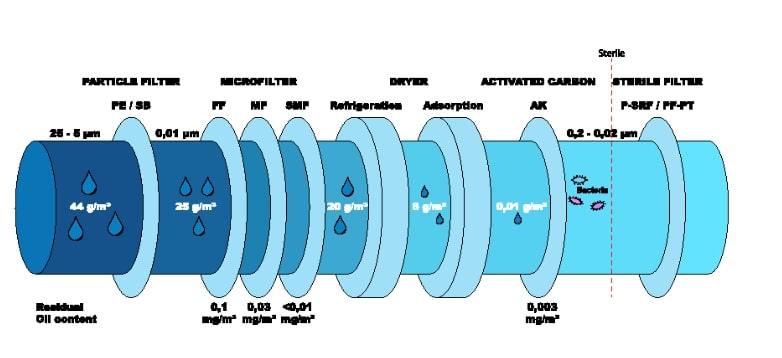
The quality of compressed air is therefore critically important. Contaminated compressed air can introduce biological contamination (viruses, bacteria) or pollution from hydrocarbons (oil in vapor, aerosol, or liquid form), as well as potentially toxic gases (CO, CO₂, H₂S, NOx) or chemically aggressive dust (e.g., acidic pH). These pollutants may also interact, potentially generating abrasive or corrosive compounds that accelerate downstream equipment wear.
Degraded oil, for example, can mix with dust and moisture in the air to form highly abrasive aerosols within distribution networks. These can prematurely wear seals and components of actuators and pneumatic distributors. Fouling of final filters, control units, pneumatic valves, and all elements in the compressed-air chain can also cause malfunctions.
Protect the entire production chain
Installing an appropriate compressed-air filter makes it possible to:
- Limit corrosion of metal components and prevent valve and pipe blockage
- Prevent microbial contamination of products manufactured on the production line, especially in the agri-food and pharmaceutical/medical sectors
- Increase the performance and service life of equipment
- Reduce the risk of fires and explosions caused by reactive pollutants present in compressed gas
- Lower maintenance costs, as well as the number and duration of maintenance shutdowns
How to choose a compressed-air filter?
To choose a compressed-air filter, several parameters must be considered, including the particle size to be removed, as well as the temperature and flow rate. It is also essential to account for the pressure losses that occur as air passes through the filter and to minimize them whenever possible.
The selected filtration system must comply with the standards applicable to the relevant industrial sector. Finally, filters should be sized strictly according to the required purification level to avoid unnecessary costs.
Each type of pollutant requires its own filtration technology
Depending on the type of pollutant to be removed, a specific filter type must be selected.
Particulate filters are used to retain dust, dirt, pollen, etc. Standard filters remove 99% of airborne particles with a diameter of 0.3 micrometers.
Coalescing filters are used to remove liquids, oil aerosols, and submicron particles (down to 0.01 micrometer) suspended in compressed air.
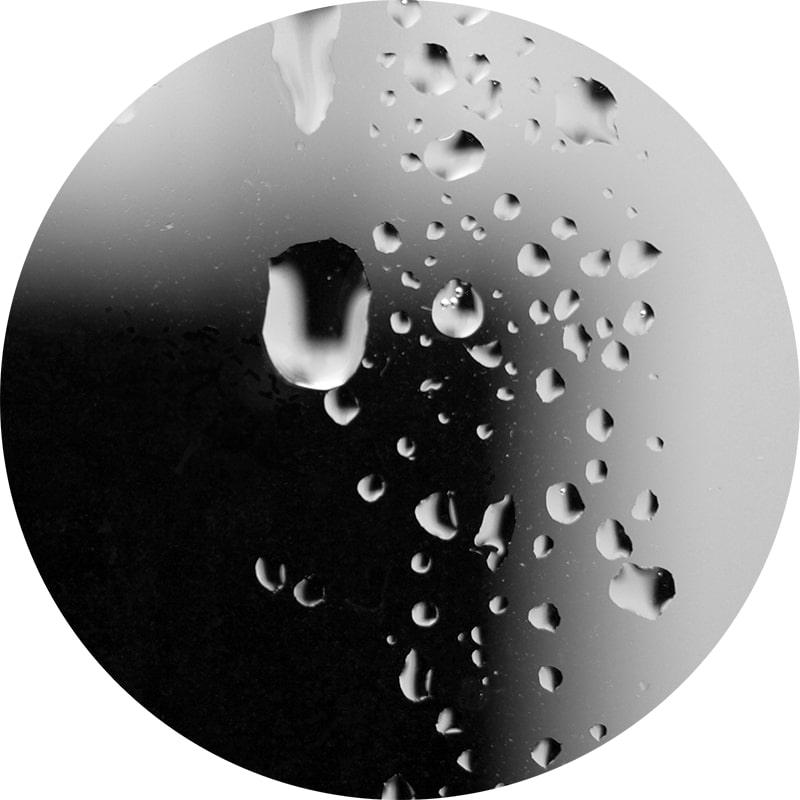
Coalescence is the process by which two identical but dispersed substances tend to merge. It is the mechanism that allows fine liquid droplets to combine into larger drops. This can be observed, for example, when raindrops on a windowpane merge into larger droplets before sliding downward once they reach a certain size.
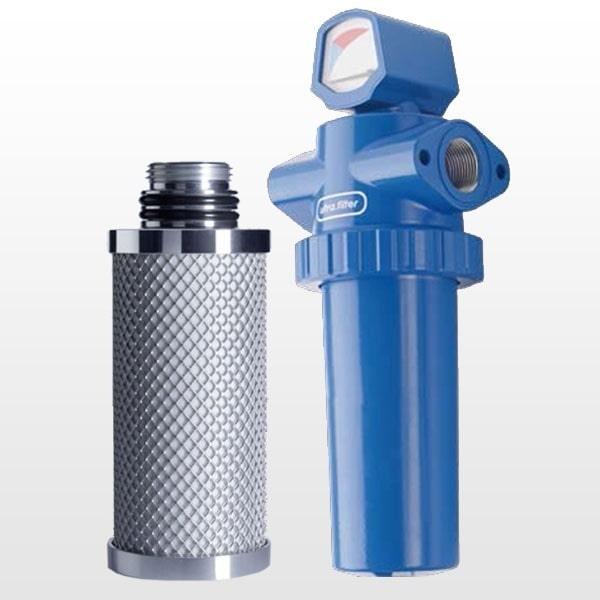
A coalescing filter contains a synthetic filter medium (such as glass fiber) that traps the particles to be removed. Beneath the filter, a dedicated sump collects the substance extracted from the compressed air, allowing it to be reused when useful (as is the case for oil).
Coalescing filters are commonly used to remove hydrocarbons. They are easy to maintain because they clog slowly, but they are not effective for removing vapors. They often include a first layer designed to separate solid substances that may still be present in the gas flow before the actual coalescing filtration takes place.
Activated carbon filters are used to remove odors and impurities through adsorption. Activated carbon can retain gases or liquids very effectively thanks to its extremely large active surface area, which gives it a very high adsorptive capacity. Molecules passing through it bind to this surface via so-called “weak” interactions (Van der Waals forces, hydrogen bonds).
Activated carbon filters are required in applications where the air must be breathable, such as in the food and pharmaceutical industries. A coalescing prefilter is typically installed upstream of the activated carbon filter. In addition, the compressed air must be dried using an air dryer.
Expert advice
With activated carbon filters, residual oil content can be reduced to below 0.003 mg/m³.
Learn more about activated carbon filters
Catalytic filter elements can also be installed to decontaminate compressed air. This type of filtration is mainly used to produce breathable air. A catalyst (for example, a mixture of copper and manganese oxides known as hopcalite) reduces the level of undesirable substances in the air through chemical reactions (oxidation of hydrocarbons into CO₂ and water, conversion of CO into CO₂, etc.). Its action is complemented by a filter media that captures all residual dust particles. It is also recommended to install a coalescing filter element upstream of the catalyst.
Molecular sieve filters use a highly porous material known as a molecular sieve. These sieves (zeolites, aluminosilicates, etc.) have a three-dimensional crystalline structure with cavities and channels whose surfaces can adsorb small molecules. Activated carbon filters are used to retain water vapor present in compressed air at low flow rates, for example in air-drying applications.
Finally, sterile compressed-air filters are used to eliminate microorganisms. Sterile compressed-air filters are employed in processes requiring the highest possible air quality, such as in the food and beverage industry, pharmaceuticals, chemical manufacturing, packaging, and the biomedical sector. The sterile filter should be installed as close as possible to the point of compressed-air use to limit any post-filtration contamination.
Expert advice
To keep the filters sterile, they must be sterilized regularly using steam.

Contact a filtration expert
We are at your service
Our experts place their knowledge and expertise at your disposal for liquid filtration, air and gas filtration, decontamination, and separation technologies.