
Industry sector: Public administration of economic activities (NAF code 8413Z)
Company activity: Research & Innovation
Company type: Public institution
Founding period: 2014
Contact: R&D Engineer
Company context
Attached to the Ministry for Ecological Transition, this laboratory develops research and innovation activities focused on road safety and sustainable mobility. This study and expertise center provides scientific support for the development, implementation, and assessment of public policies.
Filtration challenge
Through our website, the laboratory contacted us as part of the design of a new installation, requesting filtration solutions for a dual hydraulic circuit:
- Treatment of contaminated process water
- Reuse of the filtered fluid within the process
Pemflow filtration solution
Process-water filtration
The contaminated process water is routed to a 5 m³ buffer tank before being stored in a reservoir and then reinjected into the process.
Between these two tanks, two filtration stages were required to remove particles and traces of hydrocarbons.
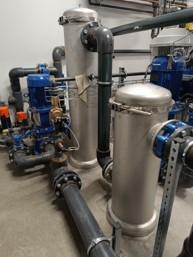
The first stage is based on installing a POROMESH© 301 / DN100 PN10 basket filter housing equipped with a POROMESH© 510 µm basket. All parts in contact with the fluid are made of 316L stainless steel.
The second stage aims to retain particles larger than 100 µm. A RAFALE single-bag filter housing fitted with a size-40 bag with a 100 µm filtration threshold was selected.
These two filtration stages, arranged in series, were sized for a flow rate of 70 m³/h.
Expert advice
For many applications involving filtration, filter bags can represent a simple, practical, and economical alternative. With felt bags, filtration occurs through mechanical retention and adsorption, as particles are trapped within the thickness of the felt. With monofilament bags, particles larger than the mesh openings are retained at the surface of the media. The choice between the two depends on the type of particles to be filtered, the need for reuse, and the required filtration level.
Storage of filtered water before reuse in the process
The filtered process water is stored in a 30 m³ tank before being reinjected into the process. Since the system does not operate continuously and the tank is not sealed, the water may be contaminated by debris from the tank and may also become a source of bacterial growth. It was therefore agreed with our client that a closed-loop filtration system was necessary to maintain water quality in line with process requirements. This solution removes impurities while keeping the liquid inside the tank.
Since the objective of the installation is to maintain a bacteriological quality compatible with process requirements, the final filtration stage is based on pleated PES membrane cartridges suitable for purified-water applications. The filtration threshold is 0.2 µm absolute (β ratio 5000 > 99.98%).
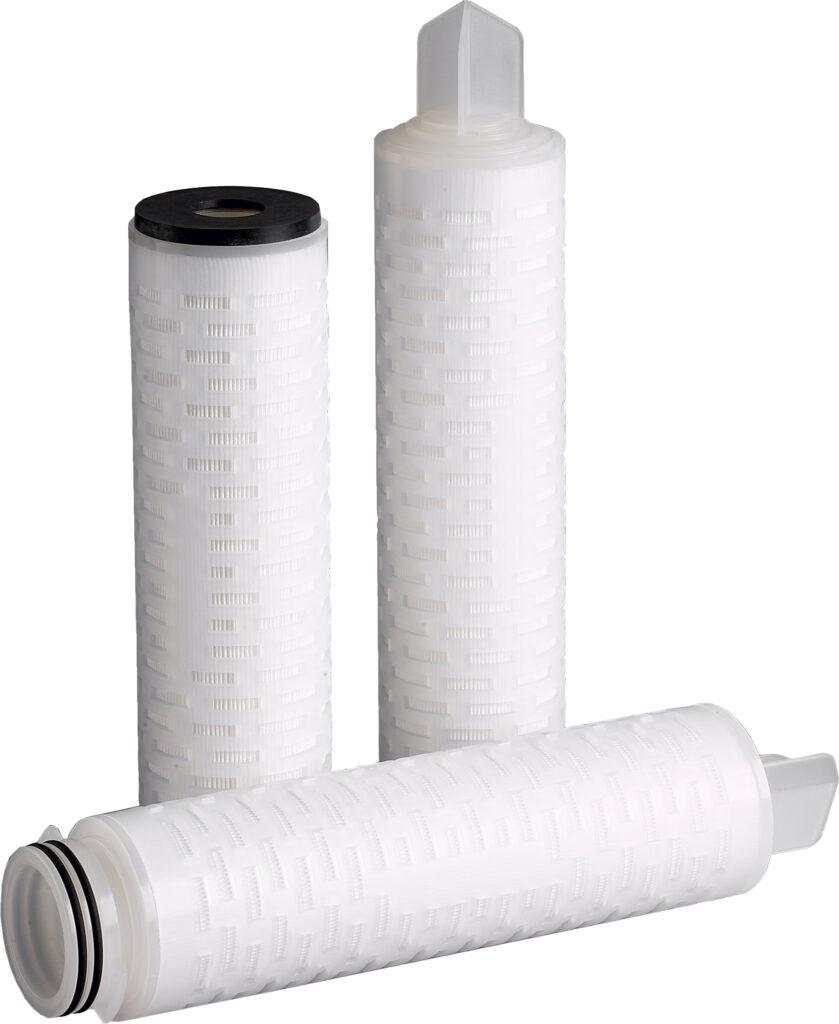
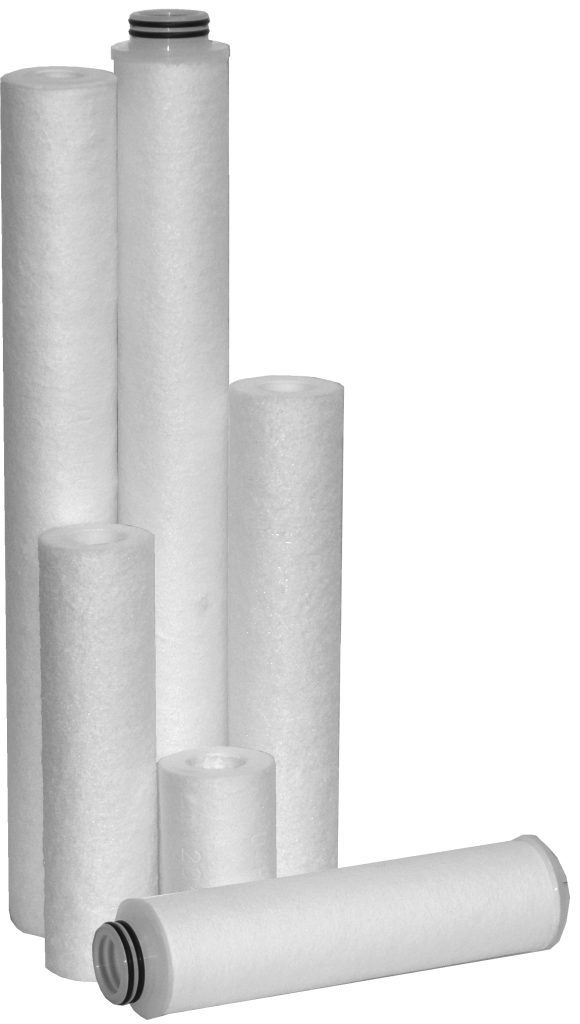
Upstream of the bacterial filtration stage, absolute-depth filter cartridges with a graded-density structure and a 5 µm threshold (β ratio 5000 > 99.989%) are used to protect the PES membranes.
This prevents premature clogging of the membrane cartridges.
Good to know
Absolute filtration:
This concept of absolute filters is found in both liquid and air filtration. In liquid filtration, a filter is considered absolute when its filtration efficiency exceeds 99.98% (beta ratio 5000).
In air filtration, absolute filters include the range of HEPA filters (filtration efficiency from E10 to H14) and the range of ULPA filters (filtration efficiency from U15 to U17).
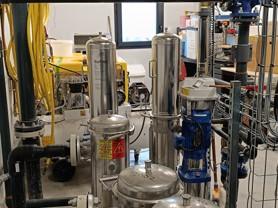
The configuration of the two filtration stages consists of two 5×30’’ multi-cartridge filter housings, compatible with a flow rate of 5 m³/h.
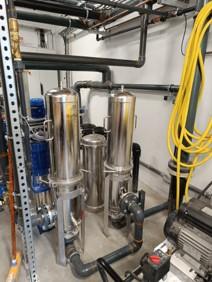
From our collaboration, our client recognized our expertise and know-how in filtration, as well as our commitment to supporting them in making effective and relevant technical choices and in the successful execution of their project.

Implementing these two filtration systems to reuse process water not only helps protect the environment but also generates savings and reduces environmental impact.
Contact a filtration expert
We are at your service
Our experts place their knowledge and expertise at your disposal for liquid filtration, air and gas filtration, decontamination, and separation technologies.