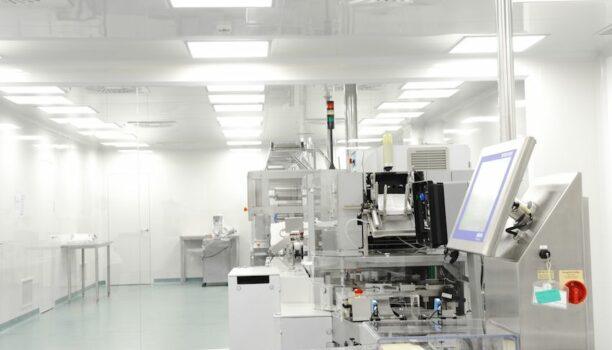
Cleanrooms are, of course, essential in pharmaceutical production. A cleanroom is a confined workspace in the sense that it must be protected from potential contamination by ambient air.
The concentration of airborne particles, as well as temperature and humidity, must be perfectly controlled. It is therefore necessary to fight simultaneously against particulate pollution and bacteriological contamination (from contaminated airborne particles), whether these are exogenous (carried in by outside air) or generated within the cleanroom itself.
The international standard ISO 14644 defines cleanrooms as: “A room in which the concentration of airborne particles is controlled, and which is constructed and used in a manner that minimizes the introduction, generation, and retention of particles inside the room, and in which other relevant parameters, for example temperature, humidity, and pressure, are controlled as necessary.”
It is estimated that natural air, even without urban pollution, contains approximately 35 million particles (diameter greater than 0.5 µm) per m³. It is therefore clear that this represents the baseline to be addressed for any facility requiring production-air filtration. This 0.5 µm size long served as the design criterion for cleanrooms, the idea being that air filtration should retain and eliminate from the cleanroom all elements “greater than or equal to” 0.5 µm. Increasing industrial requirements now impose even more restrictive standards regarding the particle size present in the air.
Sources of air contamination to be filtered
The origin of air contamination is multifactorial. The first source is outdoor air. Another, less frequently considered, comes from the installations themselves (paint and other surface coatings, HVAC debris, construction materials of the cleanroom and its contents, etc.), from particles generated by equipment in place (machining residues, lubricants), and from working and cleaning fluids (floor finishes, cleaning chemicals).
Once these are addressed, the greatest source of airborne contamination is human presence. Minute traces of cosmetics, hair, skin flakes, or clothing fibers are all sources of cleanroom contamination. Measurements show that an “immobile” worker releases about 100,000 particles per minute, whereas simply walking at 3 km/h generates 5 million particles per minute. Wearing protective garments that cover as much of the body as possible greatly reduces worker-generated contamination, but never completely: certain particles will still inevitably escape.
The aim of cleanroom air filtration is therefore twofold:
the system must reduce (ideally achieve absolute retention) of contaminants entering with the intake air, and also eliminate those generated inside the cleanroom itself.
Characteristics of cleanrooms
A cleanroom generally includes the following components:
- a sealed enclosure
- an entry and exit door, usually in the form of an airlock
- separate entry and exit ports for introducing raw materials, removing waste, etc.
- an entry point for purified fresh air
- an exit point or a series of vents for evacuating contaminated air
- utility lines such as water, compressed air, gas, and electricity as needed
- a source of breathable air when operators work with respirators
In addition, whether for ergonomic or safety reasons—or to facilitate disinfection—cleanrooms must be well illuminated, have non-slip flooring, and feature internal surfaces that are easy to clean. Corners, recesses, and any potential retention zones must be avoided.
In certain situations, cleanrooms operate under positive pressure: the room is kept at a slightly higher pressure than atmospheric pressure so that no unpurified external air can enter. Conversely, the pressure may be slightly negative to prevent any leakage toward the outside. This is the case when “toxic” materials (in the broadest sense) are handled, with a risk they could escape into the atmosphere. In such cases every “outlet”—in particular vents—must be fitted with adsorption filters (including activated carbon).
The term cleanroom covers a very wide variety of environments, especially in terms of size: the smallest may be nothing more than a closed cabinet on legs (a glove box) equipped with glove ports long enough for the operator to reach every area, while the largest may consist of a succession of rooms in which a series of operations (requiring…tant chacune parfois des conditions différentes) peut être effectuée. Les salles blanches peuvent être divisées en deux zones. Une zone dite « critique », pouvant être dotée de son propre traitement d’air, qui est la partie de la salle blanche où la contamination peut avoir un accès direct à la zone de production, et la zone générale, qui comprend le reste de la salle blanche.
Applicable standards – air filtration – cleanrooms
The general principle is to classify cleanrooms according to the level of air “cleanliness” achieved and determined in the “at-rest” state, meaning when no personnel are present in the cleanroom.
Since the industry began using controlled-atmosphere rooms, several national standards have been used, but these have now been consolidated into the international standard ISO 14644-1.
This standard consists of eight parts, notably:
- Part 1 – Classification of air cleanliness: defines a common reference framework for particulate cleanliness in cleanrooms or clean zones, providing a classification linking particle concentrations and particle size distribution.
- Part 3 – Test methods: selection of instruments, measurement procedures, and interpretation of results related to temperature measurements, airflow rates, particulate concentrations, leak testing, etc.
- Part 4 – Design, construction, and start-up: specifies the requirements from needs assessment to commissioning of the installation.
- Part 5 – Operations: covers user-related topics involving the operation, maintenance, and servicing of these environments.
- Part 8 – Classification of airborne molecular contamination: an important complement for industries concerned with chemical pollutants.
Some key figures from Part 1 of this standard are shown in Table 1 below, indicating for each ISO class the maximum number of particles of the specified size (or larger) per cubic meter of cleanroom air.
| ISO Class | 0.1 µm | 0.3 µm | 0.5 µm | 1.0 µm | 5.0 µm |
|---|---|---|---|---|---|
| 1 | 10 | – | – | – | – |
| 2 | 100 | 10 | 4 | – | – |
| 3 | 1 000 | 102 | 35 | 8 | – |
| 4 | 10 000 | 1 020 | 352 | 83 | – |
| 5 | 100 000 | 10 200 | 3 520 | 832 | 29 |
| 6 | 1 000 000 | 102 000 | 35 200 | 8 320 | 293 |
| 7 | – | – | 352 000 | 83 200 | 2 930 |
| 8 | – | – | 3 520 000 | 832 000 | 29 300 |
| 9 | – | – | 35 200 000 | 8 320 000 | 293 300 |
The general principle is to classify cleanrooms according to the level of air “cleanliness” achieved and determined in the “at-rest” state, meaning when no personnel are present in the cleanroom.
Since the industry began using controlled-atmosphere rooms, several national standards have been used, but these have now been consolidated into the international standard ISO 14644-1.
This standard consists of eight parts, notably:
Part 1 – Classification of air cleanliness: defines a common reference framework for particulate cleanliness in cleanrooms or clean zones, providing a classification linking particle concentrations and particle size distribution.
Part 3 – Test methods: selection of instruments, measurement procedures, and interpretation of results related to temperature measurements, airflow rates, particulate concentrations, leak testing, etc.
Part 4 – Design, construction, and start-up: specifies the requirements from needs assessment to commissioning of the installation.
Part 5 – Operations: covers user-related topics involving the operation, maintenance, and servicing of these environments.
Part 8 – Classification of airborne molecular contamination: an important complement for industries concerned with chemical pollutants.
Some key figures from Part 1 of this standard are shown in Table 1 below, indicating for each ISO class the maximum number of particles of the specified size (or larger) per cubic meter of cleanroom air.

Non-unidirectional airflow
“air distribution regime in which the air supplied to the clean zone mixes with the air already present by induction.”
Non-unidirectional airflow is also referred to as turbulent airflow.
Unidirectional airflow
“controlled airflow passing across the entire cross-section of a clean zone, with uniform velocity and essentially parallel streamlines.”
Unidirectional airflow is commonly referred to as laminar airflow.
Air filters in cleanrooms – air handling units – HEPA filters – ULPA filters
The air supplied to the cleanroom generally comes from one or more air handling units (AHUs) upstream (typically those treating the air of the entire facility—production and/or tertiary areas). If not, the incoming air must be processed by a dedicated air filtration system.
Whatever the configuration, the installation is similar, beginning with an air filter for coarse or fine dust (referred to in the former European standard EN 779 as G filters or F filters) serving as a pre-filter. The pre-filter is followed by a heat exchanger for temperature control and a humidifier for relative humidity control.
Next comes the circulation fan, followed by the main air quality control filter, consisting of a pre-filter to remove debris generated in the upstream equipment, then a HEPA filter (H14 filter) or ULPA filter (U15 to U17 filter) corresponding to the requirements of the targeted cleanroom class.
For easier maintenance operations, the final air filter may be installed outside the cleanroom. Installing it inside allows it to be positioned directly at each sensitive zone.

This air-handling setup, assuming an appropriate choice of final air filter, ensures the delivery of “clean” air (commonly called fresh air) into the cleanroom. However, it does nothing to address the particles generated inside the room itself. Continuous maintenance of internal air cleanliness is achieved by installing auxiliary filtration systems (often referred to as recirculated air). Each of these systems consists of one or more ducts leading to a collector, a fan, a high-efficiency HEPA or ULPA filter system, and a return duct. These filtration systems remove contaminants at their point of generation.
It is also essential to operate with appropriate air velocities, determined by the design of the air-handling systems. Conventional recommendations for “proper” sizing suggest velocities of 0.3 m·s⁻¹ for vertical flow and 0.45 m·s⁻¹ for horizontal flow. This corresponds to an airflow of 1000–1500 m³/h per m² of cleanroom surface—higher than in a standard air-conditioning system.
The air filters used to achieve the required air quality in cleanrooms are mainly standard HEPA and ULPA panel filters, with deep-pleated media. When absolute laminar flow is not required, more efficient V-block panels using mini-pleat media may be used.


Contact a filtration expert
We are at your service
Our experts place their knowledge and expertise at your disposal for liquid filtration, air and gas filtration, decontamination, and separation technologies.