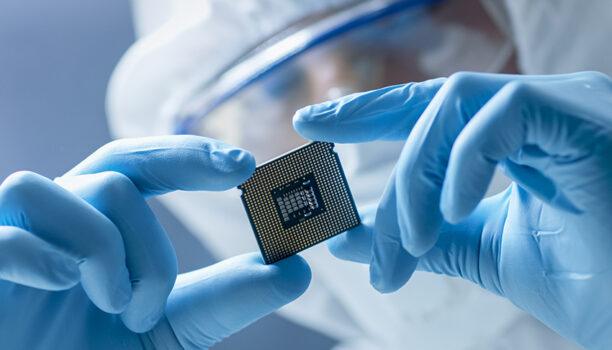
The microelectronics and semiconductor industry requires extreme cleanliness throughout the entire manufacturing chain to ensure high-precision machining.
This level of cleanliness can be achieved using high-performance filtration systems.
An adapted filtration process
The fluids used during the process must allow for flawless filtration. The microelectronics and semiconductor industry is characterised by the considerable diversity of its processes and products. It is likely the fastest-growing industry, mainly driven by the expansion of the IT and telecommunications markets, as well as the automotive and defence electronics sectors.
Advanced microelectronics manufacturing methods require extreme cleanliness of all fluids involved (Ultrapure Water, chemicals, CMP slurries, gases, air), and this requirement is constantly increasing due to ongoing miniaturisation (at the nanometric scale).
High requirements for contamination control
Contamination control is one of the most critical concerns in semiconductor manufacturing. These contaminations originate from various sources. For example, organic contaminants (TOC) can damage substrates, negatively affecting production yields.
Airborne molecular contamination (AMC) is now a major challenge for all state-of-the-art microelectronics manufacturing facilities. Likewise, the presence of submicron insoluble particles in chemicals or CMP slurries can cause scratches on wafers.
Use of Ultrapure Water (UPW)
L’industrie Microélectronique nécessite de très grandes quantités d’eau Ultrapure (UPW) dans le cadre de ses procédés de production. Le nettoyage, le rinçage et la gravure de wafers et de substrats exigent des milliers de mètres cubes d’UPW par jour dans toute usine classique. Pour répondre aux niveaux de qualité de l’eau Ultrapure (UPW) dans le secteur de la Microélectronique, le traitement de l’eau brute suit une procédure comportant plusieurs étapes, notamment celle de filtration.
Cleanroom and airborne contamination
The microelectronics industry requires very large quantities of Ultrapure Water (UPW) for its production processes.
Cleaning, rinsing and etching of wafers and substrates demand thousands of cubic metres of UPW per day in a typical plant.
To meet the stringent UPW quality requirements in the microelectronics sector, raw water treatment follows a multi-stage process, including a crucial filtration step.
Filtration and chemical products
The chemicals used in processing (etching, texturing, CMP, thin-film deposition, etc.) must be of the highest purity.
The slightest impurity can result in productivity loss, reduced yield and therefore financial impact.
Operators must be able to rely on the performance of their chemical systems to maximise yield while maintaining optimal quality levels.
Choosing the right filters for the microelectronics industry
The selected filters must meet the requirements of high-quality production, such as immediate 18 MΩ·cm resistivity recovery, no IPA contamination, etc.
For cleanrooms:
- HEPA/ULPA industrial filters (up to U15)
- Molecular filters (including activated carbon filters for adsorption at all stages of air handling units)
Whether using qualified PTFE membranes, hollow fibres, or high-purity PFA hardware, you must choose a supplier capable of recommending the industrial filters best suited to your filtration process, based on chemical and thermal compatibility.

Contact a filtration expert
We are at your service
Our experts place their knowledge and expertise at your disposal for liquid filtration, air and gas filtration, decontamination, and separation technologies.